Review
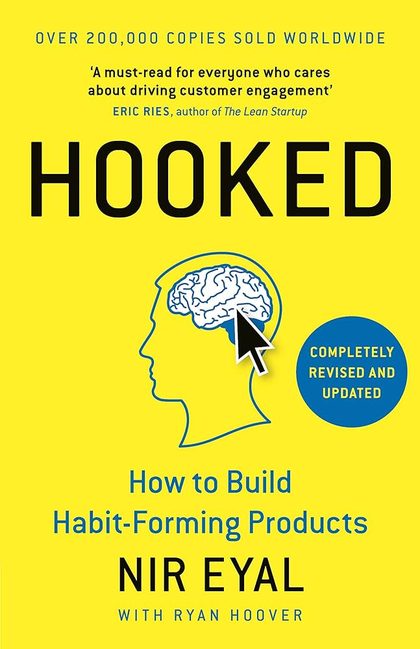
I read Hooked in August 2016, just as I was starting to think seriously about what makes a mobile product worth returning to. The notes have held up better than I expected.
Nir Eyal's central argument is tidy: a four-phase loop (trigger, action, variable reward, investment) explains why some products become daily habits and others get deleted after a week. As a framework, it's probably the clearest I've come across for thinking about engagement at the design level. The examples lean heavily on social media and gaming, which can make it feel narrow, but the underlying mechanics transfer cleanly to any consumer app.
The ethical section near the end is short but worth taking seriously. The question of whether you'd actually use your own product is a genuine gut-check, and the distinction between engaging and addictive matters more now than it did when this was published.
I build consumer apps. Every time I think about a notification strategy, a return trigger, or whether a streak mechanic is doing useful work or just manufacturing obligation, I'm using the vocabulary this book gave me. That's the real test of a framework: whether it shows up in your actual decisions.
Key Takeaways
The parts worth keeping:
The Hook Model
| Phase | What it does | What to get right |
|---|---|---|
| Trigger | Cues the behavior, externally (notification, icon, email) or internally (boredom, anxiety, curiosity) | The goal is internal: make the product its own cue, so users reach for it without prompting |
| Action | The simplest behavior performed in anticipation of a reward | Remove friction until doing is easier than thinking about it |
| Variable Reward | Satisfies the craving while leaving the user wanting more; unpredictability drives the dopamine response | Avoid finite variability: predictable rewards lose their pull |
| Investment | User contributes time, data, or effort after receiving a reward, which loads the next trigger | Ask for investment after the reward, not before it |
How habits form and why they hold
- Habits are behaviors the brain has codified so it can stop deliberating: the trigger fires, the behavior runs, no real decision made.
- Frequency is the accelerant. The more often a behavior occurs, the more automatic it becomes. People don't weigh options before searching on Google; they just search.
- Habit-forming products start as vitamins (nice to have) and become painkillers once the habit is established. The shift happens without the user noticing.
- Competing against an established habit is hard. New products need a dramatic improvement over the existing behavior, not a marginal one.
Triggers: from external cue to internal pull
- External triggers prompt behavior from outside the user. Four types: paid (advertising), earned (press, app store featuring), relationship (word of mouth), and owned (the app icon, a push notification). Owned triggers are the most durable because they persist after the acquisition cost is gone.
- Internal triggers live in the mind: emotions, situations, routines. Negative emotions (boredom, loneliness, anxiety) are especially strong because they create a discomfort that wants resolution.
- External triggers start the cycle. Internal triggers sustain it. The end goal is association: the product becomes tied to a feeling the user already has, so they reach for it automatically.
Making action easy: friction removal
- BJ Fogg's behavior model: a behavior fires when motivation, ability, and a trigger align simultaneously. In practice, ability (making the action easy) is usually the most tractable lever.
- Six dimensions of simplicity that affect ability: time, money, physical effort, cognitive effort, social acceptability, and fit with existing routine. Find the bottleneck and remove it.
- Map the path from trigger to reward and count every step. Then cut.
- Motivation heuristics that work at the perception level: scarcity (limited supply raises perceived value), anchoring (a reference point shapes what feels reasonable), endowed progress (people work harder when they feel close to finishing).
Variable rewards: three types
- Tribe: rewards tied to social connection. Recognition, belonging, seeing how others respond to you.
- Hunt: the drive to acquire information or resources. Scrolling a feed is hunting. The dopamine comes from the searching, not just the finding.
- Self: competence and completion. Clearing a queue, finishing a level, reaching a goal. These work even when the activity itself isn't enjoyable.
- Intermittent, unpredictable rewards are stronger than consistent ones. Variability keeps the dopamine response alive; predictability kills it.
- Preserve the user's sense of autonomy. Heavy-handed nudges create reactance. The reward should feel chosen.
Investment: labor leads to love
- The more effort someone invests in something, the more they value it. Eyal calls this "labor leads to love." The IKEA effect is the clearest example: furniture you assemble is worth more to you than furniture that arrives built.
- Consistency with past behavior is a strong motivator. Small prior commitments predict larger future ones.
- Four types of investment that load the next trigger: data (the product knows more about you), social graph (your network is on this platform), reputation (switching costs you standing), and skill (you've learned this specific interface).
- The investment phase is the one place where adding friction is intentional. It works because it follows a reward: ask after the user has already gotten something, not before.
Ethics and testing
- Two questions worth asking: do you use this product yourself, and does it improve users' lives? If neither is true, you know what you're building.
- Engagement is not the same as addiction. Addictions are self-destructive. The line requires honest judgment, not metrics rationalization.
- Habit testing follows three steps: identify who your most engaged users are, trace the path that got them there (the habit path), then adjust onboarding to put new users on the same route.