Review
I have run discovery cycles using JTBD framing in real product teams. I came into this book expecting either a validation or a sharper version of what I was already doing. I got a correction instead, and it is worth the discomfort.
Ulwick's case against the industry is direct. Both dominant schools of innovation, the ideas-first approach and the needs-first approach, fail for structural reasons he lays out methodically. His Outcome-Driven Innovation process claims an 86% success rate against an industry baseline of around 17%. The book earns that claim rather than just asserting it.
The book is short and dense. You cannot skim it. The part that stuck with me is the outcome statement syntax: a formula for converting vague discovery outputs into precise, measurable need statements tied to a job map and scored for opportunity. I have used it. It works better than anything I had before.
The catch is the full ODI process: 6 phases, 84 steps, trademarked. Running it properly requires C-suite mandate and probably his consultancy. Ulwick discourages partial adoption. I think the underlying framework is strong enough that selective use still beats most of what product teams call discovery today.
Key Takeaways
The parts worth keeping:
Why both standard approaches fail
- Ideas-first: generate many ideas, filter for winners. The filter is structurally broken because customer needs are never defined up front. The best solution is rarely in the consideration set. Customers cannot articulate solutions they want, only the problems they face. Success rates with this approach stay below 20%.
- Needs-first: learn what customers need, then build to meet those needs. Almost always misses a complete set of needs because there is no shared definition of what a need even is. Gathering needs in customers' own words produces the wrong inputs. Without structure, research produces themes, not actionable targets.
- The core problem with both: neither approach gives you a stable, complete, measurable definition of customer needs before you commit to a direction.
The JTBD needs framework
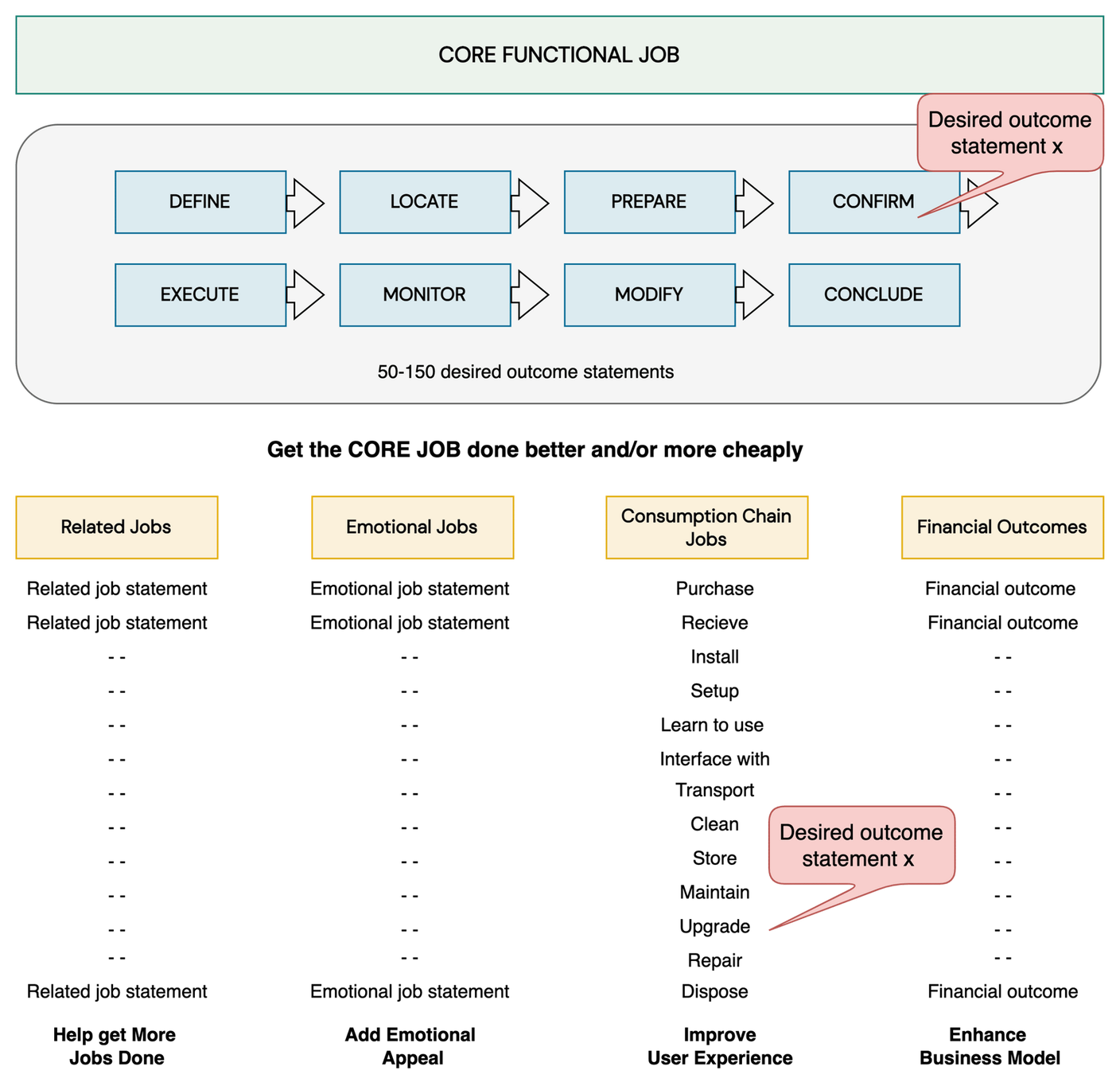
- Five categories of customer need: core functional job, related jobs, emotional jobs, consumption chain jobs, and financial outcomes.
- The core functional job is the anchor: the main task the customer is trying to execute. Format: verb + object (noun) + contextual clarifier. Example: listen to music while on the go.
- A job has three properties that make it a useful unit of analysis: stable over time, no geographic boundaries, solution-agnostic. Jobs do not change when new products appear.
- An outcome is the metric customers use to measure success as they execute a job. Outcomes are what you score for opportunity, not the job itself.
- A valid need set is mutually exclusive (no overlap between statements) and collectively exhaustive (no gaps).
Outcome statement syntax
Ulwick gives a specific formula for writing outcome statements that are measurable and comparable across research sessions:
| Component | Role | Example fragment |
|---|---|---|
| Direction of improvement | Sets the direction of success (minimize, maximize, reduce, increase) | Minimize |
| Performance metric | The variable being measured | the likelihood |
| Object of control | What is being acted on | that the signal is missed |
| Contextual clarifier | When or under what conditions | during monitoring |
Outcome statements written this way are stable, solution-agnostic, and scorable without interpretation. They are the core unit of the opportunity analysis.
Finding and scoring opportunity
- Opportunity Score = outcome importance + (outcome importance minus outcome satisfaction). High importance with low satisfaction marks an unmet need. High importance with high satisfaction marks a well-served need that is hard to disrupt.
- Segments of opportunity are defined by differences in unmet needs, not by demographics or psychographics. People in identical roles can have very different outcome priorities.
- The target: a segment large enough to be commercially attractive and underserved enough to give a new solution a genuine advantage.
- Customers are more loyal to getting a job done than to any company. When a better solution appears, loyalty follows the job.
Market growth strategy
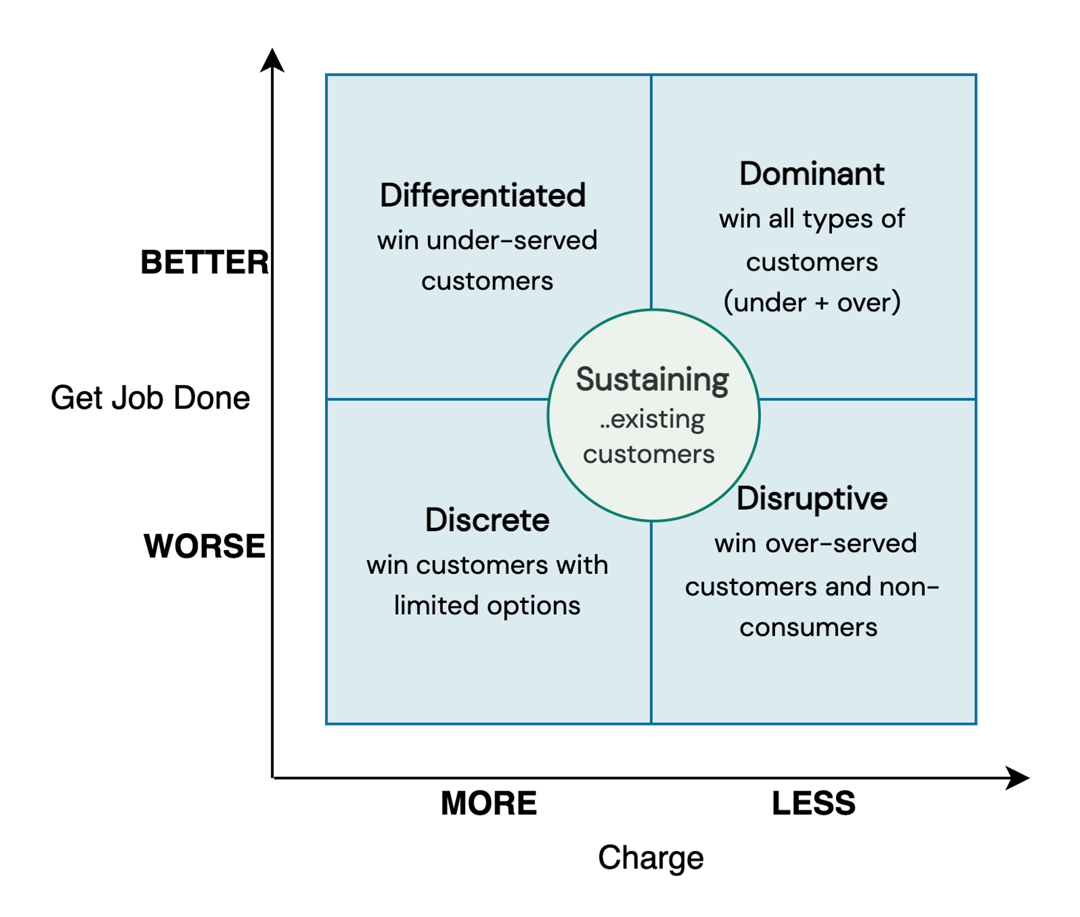
- Products win by helping customers get a job done significantly better (faster, more predictably, higher output), or more cheaply, or both. Small improvements do not shift markets.
- The growth strategy matrix maps performance against price. Significantly better at higher cost targets underserved customers willing to pay. Better and cheaper grows the total market. Cheaper and worse serves overserved customers who want the job done adequately at lower cost.
- Launching a differentiated strategy into an overserved market finds no buyers: they are already satisfied. Knowing which condition you are in before setting strategy is the point.
Implementing ODI without the full 84 steps
- Innovation should not be everyone's job. A small team of ODI practitioners sets direction. The rest of the organization builds.
- Training everyone to do innovation is a mistake: it diffuses accountability without improving outcomes. Ulwick argues for an innovation center of excellence that owns market and product strategy inputs.
- The three-phase arc for building that capability: understand your customers' jobs, discover hidden opportunities in the market, use new insights to drive growth decisions.