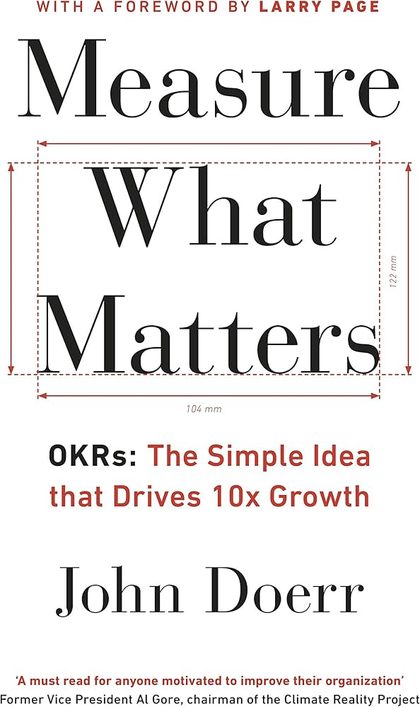
Review
OKRs are the only management framework I've seen adopted widely enough to actually matter at company scale. The methodology isn't hard to explain; getting an entire organization to apply it consistently is the harder problem. Doerr makes it concrete through case studies from Google, Intel, and others that have put OKRs to real use, which is what separates this book from a generic framework overview. You leave with a clear picture of what good looks like, not just the theory. It's not a perfect system, but it's the most credible one at this level of adoption. Start here before attempting to run OKRs across a company of any meaningful size.
Key Takeaways
The parts worth keeping
The OKR framework
- "Ideas are easy. Execution is everything."
- OKRs: a management methodology that focuses organizational effort on shared priorities at every level of the company.
- Objective: WHAT is to be achieved. Should be significant, concrete, action-oriented, and inspirational. Acts as a vaccine against fuzzy thinking and fuzzy execution.
- Key Results: benchmark and monitor HOW we get to the objective. Must be specific, time-bound, aggressive yet realistic, measurable, and verifiable. "It's not a key result unless it has a number." (Marissa Mayer)
- Assessment: at the end of the period, mark each key result complete or not. No ambiguity. If all complete, the objective is achieved. Roll over anything still important and evolve it to reflect current progress.
- A well-framed objective needs 3-5 key results. More than that dilutes focus and obscures progress.
The four OKR superpowers
- Focus and commit to priorities
- Align and connect for teamwork
- Track for accountability
- Stretch for amazing
Practical rules
- Less is more: 3-5 quarterly OKRs maximum. Innovation means saying no to a thousand things.
- Set goals from the bottom up, not just top down.
- Stay flexible: OKRs should adapt to changing conditions.
- Dare to fail: if you're certain you'll nail an OKR, you're not aiming high enough.
- OKRs are a social contract, not a dictate. Negotiate them.
- A tool, not a weapon: never tie OKRs directly to performance ratings.
- Be patient and resolute. It takes a few cycles to implement OKRs well.
- A 3-month time horizon curbs procrastination and speeds up feedback loops. The best OKR cadence is the one that fits your business.
- Output drives productivity, not activity. At Intel, what mattered wasn't what you knew; it was your effectiveness in translating knowledge into results. Accomplishment beats credentials.
- Occasionally a key result is strong enough to warrant elevation to an objective.
- "At any given time, some significant percentage of people are working on the wrong things. The challenge is knowing which ones." (Aaron Levie)
Common pitfalls
- The key risk: specific challenging goals get met at the expense of things not measured (safety, ethics, quality). Pair key results with quality goals or non-goals to prevent gaming.
- Relying on top-down cascading reduces agility (everyone waits for leadership), reduces flexibility (people avoid revising mid-cycle), and marginalizes front-line contributors. Healthy OKRs balance alignment with autonomy.
- Unacknowledged dependencies are the number one cause of project slippage. Transparency helps horizontal collaboration. Teams like engineering often get caught between competing OKRs; make dependencies explicit.
- You may need to fix your culture before implementing OKRs. You need to be ready for openness and accountability. Collins put it well: get the right people on the bus, get the wrong people off, get the right people in the right seats. Only then do you turn the wheel.
- The most powerful cultural force is active transparency: opening up, sharing the truth, bringing others in.
Google's two OKR types
| Type | Definition | Expected completion |
|---|---|---|
| Committed | Goals the team commits to achieving in full | 100% |
| Aspirational | Ambitious goals that stretch capability | ~60-70% (40% complete is acceptable) |
Managing OKRs mid-cycle
- Continue: if on track (green zone)
- Update: modify if conditions have changed (yellow zone)
- Start: launch something new if the opportunity arises
- Stop: drop it when it's no longer useful (red zone)
If you change an OKR mid-cycle, notify everyone: what changed, what you learned, and what you'll do differently next cycle.
Reflection questions
- Did I accomplish all of the objectives? What contributed to success?
- If not, what obstacles did I encounter?
- If I were to rewrite a goal I achieved in full, what would I change?
- What have I learned that might alter my approach to the next cycle?
CFRs: the companion to OKRs
Continuous Performance Management replaces annual reviews. Implemented through CFRs:
- Conversations: authentic, textured exchanges that drive performance
- Feedback: networked among peers to evaluate progress and guide future improvement
- Recognition: expressions of appreciation to deserving individuals for contributions of all sizes
OKRs should account for less than 30% of performance ratings (Google's benchmark). They're context, not a scorecard.
Useful 1:1 agenda: goal setting and reflection, progress updates, two-way coaching, career growth, lightweight performance review. Feedback needs to be specific to be constructive.