Review
What is it about? Was it worth reading?
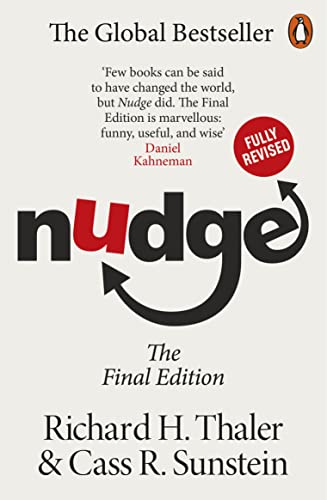
Nudge landed on me in 2018 and the central idea has stuck: the design of choice is never neutral. Once you have that framing, you cannot look at a sign-up form or a retirement enrollment default without seeing the choice architect behind it.
My main criticism is that the theory is strong but the bridge to practice is short. The examples are well chosen and convincing, but the gap between understanding nudge and actually designing a better one is left largely to the reader. For a book so interested in helping people make better decisions, that is a little ironic.
Worth reading if you build systems, design products, or set policy. Just know the application work is yours to do.
Key Takeaways
The parts worth keeping
The core concepts
- Choice architect: anyone who organizes the context in which people make decisions. You can be one without knowing it. There is no such thing as a neutral design.
- Libertarian paternalism: preserve freedom of choice while designing defaults that guide people toward outcomes that serve their interests.
- Nudge: altering behavior in a predictable way without restricting options or changing economic incentives. It works because humans are not rational Econs.
How humans actually decide
We make thousands of decisions a day and cannot think carefully about each one, so we use shortcuts. These help most of the time but create predictable failure modes.
- Anchoring: we start from an initial anchor and make insufficient adjustments, even when the anchor is irrelevant.
- Availability: we judge the likelihood of events by how easily examples come to mind. Memorable events feel more probable than they are.
- Representativeness: we judge how likely it is that A belongs to category B by how closely A matches our stereotype of B.
- Overconfidence: 90% of drivers believe they are above average. Unrealistic optimism explains a lot of risk-taking and why lotteries work.
- Loss aversion: losing something feels roughly twice as bad as gaining the equivalent. It feeds inertia and hesitancy to let go of the status quo.
- Status quo bias: the tendency to stick with the default, often expressed as a "yeah, whatever" response to unfamiliar choices.
- Framing: the same fact lands differently depending on how it is presented. "90 out of 100 will survive the operation" and "1 in 10 will die" describe identical odds.
We operate in two modes: the automatic system (fast, intuitive, tied to older parts of the brain) and the reflective system (slow, deliberate, self-conscious). Nudges work by cooperating with the automatic system rather than demanding that the reflective one show up every time.
Self-control and present bias
- We systematically underestimate the pull of temptation in the moment. The "planner" self wants long-term welfare; the "doer" self faces the actual temptation.
- Pre-commitment is one of the strongest self-control tools: lock in a future behavior before temptation arrives.
- Time gaps between choice and consequence cause most self-control failures. Investment goods (exercise, saving) require sacrifice now for reward later; temptation goods (alcohol, Netflix) deliver pleasure now and costs later. Free markets rarely correct for this because more money can often be made catering to frailty than to prudence.
Social influence
- Humans are influenced by other humans through two mechanisms:
- Informational influence: we overweight what other people's choices signal, treating observed behavior as evidence about what is correct.
- Peer pressure: we want to fit in and avoid disapproval, which can cause cascades where the crowd becomes self-reinforcing.
- Informational cascade: when people reveal preferences in sequence, early choices nudge later ones. Social norms spread this way.
- Pluralistic ignorance: everyone privately disagrees with a social norm but publicly conforms, because they assume everyone else believes it. When the truth surfaces, norms can shift quickly.
- Social nudges are effective and cheap. Tax reminder letters became significantly more effective when they added that 9 in 10 people in the same area pay on time. Telling people what their neighbors are actually doing is low-cost and high-effect.
- People respond to norms set by similar others in similar circumstances, far more than to celebrity endorsements.
Nudge design tools
- Make it easy. If you want to encourage a behavior, reduce friction. The simplest nudge and the most underused.
- Defaults. Most people follow the path of least resistance. If a default exists, expect a large share of people to end up there. Design defaults to point toward outcomes that serve the chooser.
- Required choice (mandated choice): remove the default entirely and force a decision. Overcomes inertia and reveals actual preferences without guessing.
- Expect error. Systems should assume humans will make mistakes and be as forgiving as possible. Good examples: ATMs that require you to take your card before dispensing cash; diesel nozzles that do not fit petrol cars; Gmail prompting you when you mention "attachment" but forget to attach the file. These are called forcing functions.
- Feedback. Well-designed systems tell people when they are doing well and when they are making mistakes. Energy dashboards showing neighborhood comparisons reduce consumption by around 2%.
- Mappings. Help people understand what a choice will actually mean in use. Transform numerical information into units that connect to real experience.
- Incentives. Ask: who chooses, who uses, who pays, who profits? Salience matters most; make sure the chooser can actually see the incentives they face.
- Prompts and reminders. Our most common mistake is simply forgetting. Well-timed prompts are underrated nudges. Asking voters in advance exactly when, where, and how they plan to vote increases turnout by roughly 4%.
- Checklists. Among the most powerful nudges for complex tasks, and they also give junior people a legitimate reason to speak up.
Sludge and dark patterns
- Sludge is nudging for bad: any aspect of choice architecture that creates friction making it harder for people to obtain an outcome that would benefit them.
- Dark patterns are deliberate uses of sludge online:
- The unsubscribe trap: asymmetry between the ease of joining and the pain of leaving.
- Rebates: a refund is offered but redemption is made hard enough that only 10-40% of buyers actually claim it.
- Shrouded attributes: the headline price understates the true cost because the expensive parts are hidden. Sell the printer cheap; make the money on the ink.
- Competition does not reliably eliminate sludge. "Free Bank Account" is better marketing than "Bank Account, $100/year, no hidden fees," even if the second is the better deal.
- Governments impose significant costs on citizens through sludge in public service design. The real cost of airport security is mostly the time spent waiting, not the fee charged.
Applications worth noting
- Retirement savings. The "Save More Tomorrow" plan invites people to commit in advance to contribution increases timed to coincide with pay raises. It reduces the sting of loss aversion because you are giving up future income rather than current income. Default enrollment (opt-out rather than opt-in) dramatically increases participation. Sweden's alternative, which relied on active choice and celebrity fund advertising, performed worse; participants rarely revisited initial choices, even after fraud allegations against specific funds.
- Organ donation. The gap between opt-in and opt-out defaults is enormous: roughly 12% of Germans opt in; roughly 99% of Austrians do not opt out. The authors ultimately advocate for prompted choice over presumed consent, because it provides a stronger signal of genuine preference while still overcoming inertia for willing donors. The US captured 170 million donor registrations through the driver's license process.
- Climate change. Collective action is hard for five specific reasons: present bias (the worst effects are decades away), low salience (greenhouse gases are invisible), no identifiable villain, probabilistic harms that diffuse responsibility, and loss aversion around immediate costs. Low-cost nudges alone will not solve it. Mandated greenhouse gas disclosure helps, as does showing households how their energy use compares to neighbors. A "Green More Tomorrow" commitment structure mirrors Save More Tomorrow and could ease the loss aversion problem by locking in gradually increasing costs over time.