Review
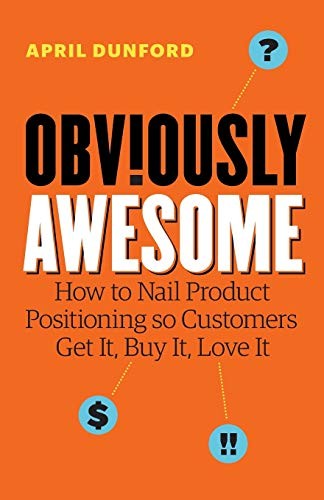
Positioning is one of those words that everyone uses and almost nobody can define operationally. Dunford's book is the first thing I read that treated it as a solvable problem with a procedure attached.
Her central move is to stop treating positioning as a creative writing exercise and start treating it as a question of context. The same product, framed as a competitor to a different category, becomes obvious rather than confusing. She has an example running through the book where a product goes from unsellable to obvious purely by changing what customers compare it to, with no change to the software at all.
What I took into my own work is the sequence: find the customers who already love it and ask why, work out what they'd use if you disappeared, isolate the capabilities only you have, then choose the market frame that makes those capabilities matter. That order is the opposite of how positioning usually gets done, which is to pick an aspirational category first and reverse-engineer the story.
The book is short and free of filler. My only real criticism is that it assumes you have happy customers to learn from, and if you don't yet, the method has nothing to grip. Read it before you write another homepage.
Key Takeaways
The parts worth keeping:
Positioning is context, not copy
- Customers understand a new thing by comparing it to something they already know. The comparison they reach for by default may be actively harmful to you.
- Choosing the frame is the decision. The words are downstream, and rewriting the words without changing the frame achieves very little.
- The same product in a different category can move from confusing to obvious with no change to the product.
The sequence
| Step | The question |
|---|---|
| 1 | Which customers already love us, and why? |
| 2 | What would they use if we vanished tomorrow? |
| 3 | What can we do that those alternatives cannot? |
| 4 | What value do those capabilities actually deliver? |
| 5 | Who cares a great deal about that value? |
| 6 | Which market frame makes all of it obvious? |
- The order matters. Starting at step six, picking the category you want to be in, is how positioning normally goes wrong.
The alternative is rarely a competitor
- What customers would otherwise do is often a spreadsheet, a manual process, or nothing at all. Positioning against a named rival when the real alternative is inertia misses the actual argument.
Positioning has a shelf life
- It shifts as the market matures, as competitors reframe, and as your product changes. Treating it as a one-time exercise means it slowly stops fitting.
- The signal that it has drifted is usually that sales conversations start needing more explanation than they used to.