Review
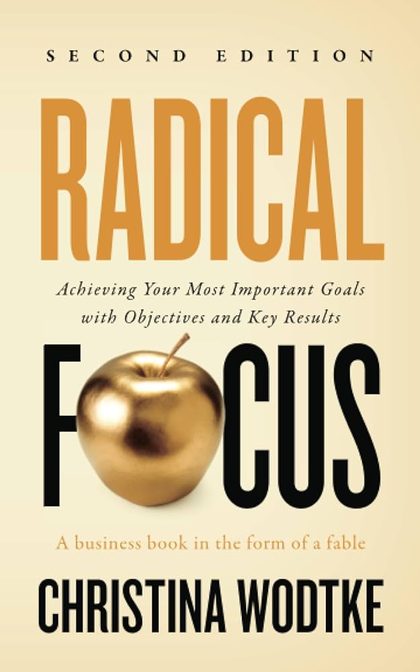
I've read more OKR books than I'd like to admit. Most of them spend the majority of their time selling you on why OKRs are brilliant, which is not the hard part. Radical Focus does something rarer: it tells you where they break down. Christina Wodtke is a genuine proponent, but she is also direct that operations teams do not need OKRs, and she offers real adaptations for exploratory work rather than forcing a single model onto every context. That combination of conviction and nuance is what makes this one worth the time. It covers the rough edges more honestly than most, and that is where OKR implementations actually fail.
Key Takeaways
The parts worth keeping:
What are OKRs?
- OKRs stand for Objectives and Key Results. The Objective is what you want to achieve. The Key Results are how you know you achieved it.
- An Objective should be:
- Framed in a single sentence
- Qualitative and inspirational (something that gets you out of bed in the morning)
- Time-bound, typically a quarter
- Actionable by the team independently, with no external dependencies
- Hard but not impossible in the time frame
- Key Results should be:
- Quantitative
- Roughly 3 per objective (1 minimum, 5 maximum)
- Balancing across different dimensions (e.g. growth and quality, not just one axis)
- Set at 50% confidence: a genuine 50/50 shot at hitting them
- How to generate good Key Results:
- Find words in the objective sentence that can be quantified
- Free-list candidate metrics as a group, then stack-rank by trustworthiness and ease of measurement
- Think through anti-goals to guard against gaming the system
- Do not use projects or tasks as KRs. KRs should leave room to change approach if the first tactic does not work
- OKRs move teams from output thinking to outcome thinking. You are time-constraining work that is important but not urgent, which makes it urgent.
- OKRs are the right tool for change and innovation, not for maintenance. Operations teams that sustain existing services should use Health Metrics instead.
Weekly check-ins
- Weekly check-ins are the mechanism that makes OKRs work. The repetition is what keeps them real, not the goal-setting ceremony at the start of the quarter.
- The check-in document has four quadrants: OKRs with weekly confidence scores, prioritized weekly intentions, Health Metrics, and a 4-week rolling forecast.
| OKRs | Intentions for the week |
| Objective 1 KR 1 · Confidence % KR 2 · Confidence % KR 3 · Confidence % Objective 2 KR 1 · Confidence % KR 2 · Confidence % KR 3 · Confidence % | P1: Task 1 P1: Task 2 P2: Task 3 P2: Task 4 P3: Task 5 |
| Health Metrics | Next 4 weeks Forecast |
| H.Metric 1 H.Metric 2 H.Metric 3 | Item 1 Item 2 Item 3 Item 4 |
- Health Metrics stop you from gaming the system: they protect what you have already built while you push toward the new objective.
- OKRs give you permission to say no. If work does not move any KR forward, it is a strong candidate for deprioritization.
- Cadence: Monday to set intentions, Friday to acknowledge what was achieved. Short Friday status updates build cross-team learning and keep everyone aligned without a meeting.
Setting OKRs across the organization
- Do the hard work to agree on a single company objective. Multiple objectives multiply complexity fast: 5 objectives with 5 KRs each means 20 priorities for every person to track.
- Trust teams to set their own OKRs based on company strategy. If you have a mission, a strategy, and an annual OKR, they will not go far wrong.
- Cascading OKRs does not scale beyond small, flat organizations.
- Be deliberate about rollout. The first cycle is likely to fail, which can cause disillusionment. Safer approaches:
- Pick a single high-performing team to go first, then share their results loudly
- Start with one OKR for the entire company
- Apply OKRs to projects first to build the outcome mindset before scaling
- Prerequisites for OKRs to work: executive trust in the team, a simple and memorable mission, a clear strategy, instrumented product metrics, and psychological safety.
Pipelines over roadmaps
- The book argues that pipelines are a better format than roadmaps for storing potential initiatives. Roadmaps have dates baked in; pipelines stay flexible, using impact, effort, and confidence for prioritization instead.
Scoring OKRs
- Score your OKRs numerically. Numbers bring reality to the surface and improve KR quality over time: you get better at writing targets that are genuinely measurable and unambiguous.
- Three approaches to scoring, each with real trade-offs:
| Approach | Results Scoring | Confidence Scoring | Milestone Scoring |
|---|---|---|---|
| What | Update of actual results achieved so far | Is the team on track to deliver the results? | How much of the initiative has been completed? |
| Pros | Clear and transparent. Incentivises metric-driven KRs and getting results checked before end of quarter. | Can show progress before results materialise | Can show progress before results materialise |
| Cons | Can be demoralising when scores do not reflect real effort | Risk of shipping the initiative without the results. Can drift into pure project management. | Risk of shipping the initiative without the results. Can drift into pure project management. |
- Results scoring scale:
| Score | How to read it |
| 1.0 | Complete success |
| 0.7 to 1.0 | Achieved. Strong result. |
| 0.3 to 0.7 | Partial progress. 0.6+ is still genuinely good. |
| 0.0 to 0.3 | Failure. Learn from it. |
- Set the exact thresholds for each score grade when you write the KR, not at the end of the quarter when rationalising is easy.
- For confidence scoring: start each KR at 50% and update weekly. Expect the number to swing. Two weeks from end of quarter, call it: double down on the ones you might still hit, deprioritize the rest.
- A low score is not always bad news. It can mean the work surfaced valuable learnings, a KR was deprioritized for something more important, or you discovered you were tracking the wrong metric. The conversation after the score matters more than the number itself.
- Scoring throughout the quarter matters more than the final number. But do the final score: reflect, gather learnings, carry them into the next cycle.
Flavors of OKRs
| Exploratory OKRs | For early-stage and R&D work. KRs are designed to test whether you have something worth pursuing. Leaves room for experimentation while still holding the team to a measurable end state. |
| Hypothesis OKRs | For validating strategy. The objective states a success condition; the KRs prove whether it is true. Achieving them is evidence of product-market fit. Failing them gives you permission to pivot. |
| Milestone OKRs | For large multi-quarter initiatives. Milestones reduce risk by creating natural pause points for iteration. The KRs define what good looks like at each stage, not just at the end. |
After the numbers
- The score is a guide, not the verdict. At end of quarter, combine the OKR scores with broader context: business-as-usual performance, KPIs, team events, new challenges and opportunities.
- Keep a running quarterly document with three sections: Highlights (strong results), Groundwork (effort made but not yet showing in the numbers), and Lowlights (areas that did not progress).
- No one remembers the scores six months later. They remember what happened and what was learned.
Tooling
- Buying a tool is the last step, not the first. Start lightweight, experiment with different approaches, and wait until you have genuinely mastered the process before going shopping.