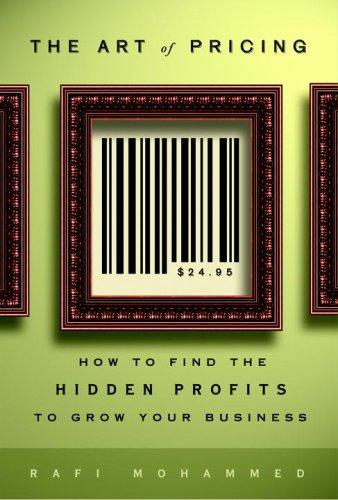
Review
Pricing is the lever most product teams touch least and the one with the most direct effect on the business, which is a strange combination and roughly why I read this.
Mohammed's core argument is that a single price is a decision to serve one type of customer and turn away everyone whose willingness to pay sits above or below it. Both groups represent money left on the table: the ones who would have paid more, and the ones who would have bought something cheaper. Most of the book is about capturing both without annoying either.
The practical content is around versioning: offering different bundles at different prices so customers sort themselves. That's now standard practice in software, which makes parts of the book feel obvious in a way it presumably wasn't when written.
What I still find useful is the insistence on starting from what the customer gains rather than what the thing costs you to make. Cost-plus pricing is everywhere, it's easy to defend internally, and it systematically underprices anything valuable. The book is a bit dry and the examples skew to retail, but the reframe earns its place.
Key Takeaways
The parts worth keeping:
One price serves one customer
- Any single price leaves two groups unserved: those who would have paid more, and those who would have bought a lesser version.
- Willingness to pay varies enormously for the same product depending on the situation someone is in. A single number cannot capture that.
- The goal is to let different customers pay different amounts without either group feeling badly treated.
Price from value, not from cost
- What it cost to build tells you the floor, and nothing about the ceiling. Cost-plus pricing is easy to justify internally and reliably underprices good products.
- Start from what the customer avoids, saves or gains. That number is often much larger than anything your cost base would suggest.
- The reference point matters more than the absolute figure. What the buyer compares your price to determines whether it feels reasonable.
Let customers sort themselves
| Approach | How it separates buyers |
|---|---|
| Versioning | Different bundles for different needs and budgets |
| Usage-based | Heavier users pay more, which usually tracks value |
| Segment pricing | Different rates by customer type where that is defensible |
| Timing | Early or late buyers pay differently |
Test it like anything else
- Pricing is treated as a one-time decision far more often than it is treated as something to learn about, which is odd given how much rests on it.
- Small changes compound quickly, and the cost of being wrong in one direction is very different from the other.