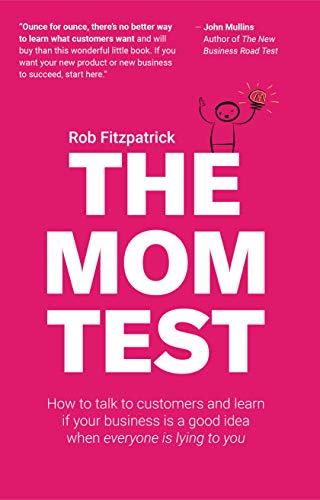
Review
I keep coming back to The Mom Test whenever I'm about to run a round of discovery interviews. I first read it in June 2020, just before a discovery project, and the timing was good. The book's central premise is that you can't ask people whether your idea is good, because they will lie to protect your feelings, and every question Fitzpatrick teaches is built around navigating that constraint. The good/bad questions framework is one of those things that changes how you think the moment you read it. It's a short book with no padding. If you interview customers as part of your product work, this belongs on your reading list.
Key Takeaways
The parts worth keeping
You can't ask people if your idea is good. They're too polite to tell you the truth. The book is about engineering around that fact: better questions, better conversations, the discipline to stop pitching and start listening.
The three rules
- Talk about their life, not your idea. Don't pitch it. Don't even mention it until the end.
- Talk about specifics in the past, not generics in the future.
Would you ever do x?→ When did you last do x? - Talk less, listen more. Stop pitching. Shut up and take good notes.
Good questions and bad questions
Every customer conversation is bad by default. Your job is to fix it.
| Bad Questions | Why They Fail |
|---|---|
| Do you think it's a good idea? | Opinions are worthless. Only the market can tell you. |
| Would you buy a product that did x? | Future-looking statements are over-optimistic lies. |
| How much would you pay for x? | People lie when they think it's what you want to hear. |
| What would your dream product do? | People know their problems, not how to solve them. |
| Would you pay x for something that did y? | People stop lying when you actually ask them for money. |
| Good Questions | What They Reveal |
|---|---|
| Why do you bother to do x? | Is the problem real? |
| What are the implications of that? | Product risk |
| Talk me through the last time that happened | Can I grow this? |
| What else have you tried? | Customer and market risk |
| How do you currently solve x? How much does that cost you? | Will they pay me? |
| Who controls the budget? Who decides? | Where the money comes from (B2B) |
| Who else should I talk to? What else should I have asked? | End every conversation here. People want to help. |
Deciding what to build is your job. Gather information about them. Make the visionary leap to a solution yourself. They own the problem, you own the solution.
Three types of bad data
- Compliments. If you ask for feedback you're really asking for compliments. Deflect them. Notice when you get one, then steer back: "How do you solve the problem now?"
- Fluff. Generic claims ("I usually..."), future tense promises ("I would..."), hypothetical maybes ("I might..."). Turn them concrete: "When did it happen last?" "Talk me through it step by step."
- Ideas and feature requests. Don't dismiss them, anchor them. "Why do you want that?" If they have a costly workaround, it's interesting. If not, it's probably not a priority.
How conversations go off track: you find yourself pitching, you revealed your idea too early, or you both drifted into hypothetical territory.
Commitment and advancement
A meeting with no clear next step is a zombie lead. Give them the chance to commit or reject. Pop the question.
The currencies of commitment (something they give up that costs them something real):
- Cash: a deposit, a letter of intent
- Time: a trial, training for colleagues
- Reputation: a testimonial, a pilot, an introduction to their boss
Compliments aren't commitment. They're a red flag. The customer profile worth targeting: someone who has the problem, knows they have it, has budget to solve it, and has already cobbled together a makeshift solution.
Choosing your customer segment
- Startups don't starve, they drown in options. A segment that's too wide gives you mixed feedback, infinite options, and no clear way to invalidate anything.
- You want ten conversations with the same type of customer, not one conversation with ten different types.
- Customer slicing: keep narrowing until you have a clear sense of who you're talking to and where to find them. Find the subgroup that wants it most.
- Ask yourself: am I talking to the wrong people? Too broad a segment? Missing a subgroup? For B2B: am I reaching the actual decision maker?
Before, during, and after
Before:
- Identify 3 big learning goals per type of person you'll speak to
- Do desk research first. Don't use conversations to answer things you could find out another way.
- Decide the tough questions with your team before you go in
During:
- Frame early: you're learning, not selling
- Keep it casual. A formal interview makes people clam up.
- Deflect compliments, dig beneath signals, push fluffy answers back to concrete specifics
- Two people works best: one talks, one takes notes
- Always push to a clear next step or commitment before you leave
After:
- Review notes with your team the same day. Update beliefs and questions.
- Get the raw data out of your head and into something shareable
- Stop doing conversations when you stop hearing anything new