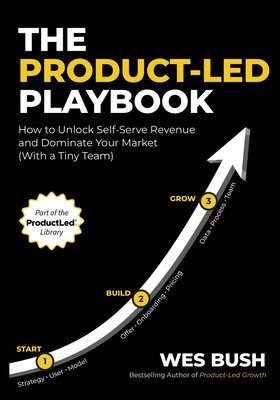
Review
Bush's follow-up to Product-Led Growth, and it's the more useful of the two because it assumes you've accepted the argument and want to know how the work is actually sequenced.
The framing that improved on the first book is the honesty about who this fits. He is clearer that product-led is a set of conditions rather than an aspiration, and that adopting it without a product which can demonstrate its own value is a way of removing your sales function and keeping the problem.
The material on the free experience is the most practical. His argument is that the free tier has to deliver a genuine outcome rather than a preview, and that the paywall should sit where a succeeding user hits a limit rather than where an evaluating user hits a wall. That distinction is subtle in writing and enormous in practice.
My reservation is the same one I had about the first book: the case studies are drawn from companies where the model already worked, and the failures are underexplored. There's also a fair amount of repetition, both within the book and from its predecessor. If you're choosing one, choose this one.
Key Takeaways
The parts worth keeping:
Conditions, not aspirations
- The model needs a product whose value can be experienced without a person, buyers willing to try before talking, and economics that support self-service.
- Where those don't hold, going product-led removes the mechanism that was making the sale and replaces it with nothing.
- Plenty of companies adopt the language without meeting any of the conditions, then conclude the model doesn't work.
The free experience has to deliver
- A free tier that previews value rather than delivering it produces sign-ups and no conversion, because nobody has felt anything yet.
- The user should reach a real outcome while still paying nothing. That outcome is what makes the limit worth paying to remove.
Where the wall goes
| Limit hit while | Result |
|---|---|
| Succeeding and wanting more | Upgrade feels like removing a constraint |
| Still evaluating | Feels like a toll gate, and they leave |
Sequence the work
- Fix the path to first value before optimising acquisition. More people arriving at a broken onboarding produces more disappointment, not more revenue.
- Instrument the steps to that first outcome specifically, since aggregate funnel numbers hide exactly where people give up.
- Sales does not disappear in this model; it moves later and serves the accounts where a human genuinely adds value.