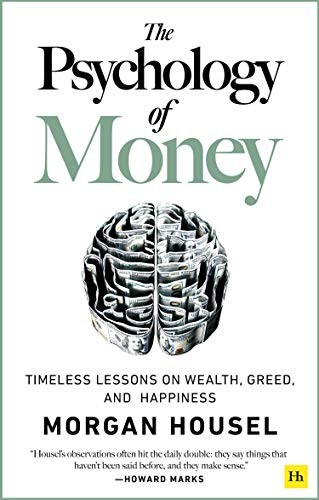
Review
A book of short essays about financial behaviour rather than financial technique, and it is the rare popular book that I think is genuinely better than its reputation.
Housel's argument is that doing well with money depends far more on behaviour than on knowledge, and that behaviour is shaped by experiences you did not choose. Someone who entered adulthood during a crash holds different beliefs about risk than someone who did not, and both think they are being rational. That is a more generous and more accurate account of disagreement than the usual one.
The essay on the difference between getting wealthy and staying wealthy is the one I have thought about most. They require opposite behaviours: one needs risk and optimism, the other needs paranoia and survival. Confusing them explains a lot of otherwise inexplicable decisions, and not only financial ones. The same tension shows up in companies that cannot stop behaving like a startup.
Because it is essays, it repeats itself and does not build. There is no method here and nothing to implement. Read it for the reframing, which is durable, rather than for advice, of which there is very little.
Key Takeaways
The parts worth keeping:
Behaviour beats knowledge
- Financial outcomes depend more on how people behave under stress than on what they understand. Intelligence is a weak predictor.
- People with identical information make opposite decisions because their formative experiences differ, and each set of beliefs is reasonable given the life that produced it.
- Calling other people's financial decisions irrational usually means you have not asked what they lived through.
Getting there and staying there are opposites
| Goal | What it requires |
|---|---|
| Getting wealthy | Risk, optimism, concentration, putting yourself out there |
| Staying wealthy | Humility, caution, and a plan for surviving the bad case |
- The behaviours that produce the first actively endanger the second, which is why the same person often does both badly at different points.
Room for error is the whole strategy
- Plans should survive being wrong, because the point of a plan is to work when things do not go as expected.
- Surviving long enough for compounding to operate matters more than any individual decision along the way.
Enough is a decision
- Without a defined idea of sufficient, the target moves upward permanently and no outcome registers as success.
- A great deal of visible spending buys the expectation of admiration from people who are not paying attention.
- The strongest thing money buys is control over your own time, which is rarely the thing it gets spent on.