Review
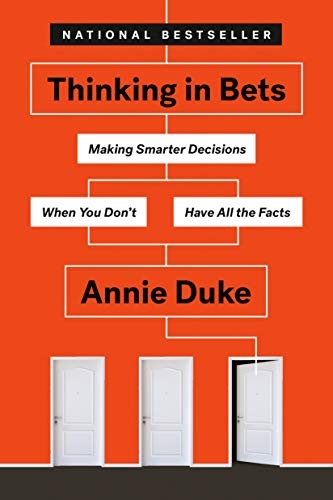
Duke was a professional poker player before she wrote about decision-making, and the book is built on one idea from that world that I think most organisations need badly.
The idea is the separation of decision quality from outcome quality. In a game with hidden information and chance, a good decision can lose and a bad one can win, so judging your process by its results will teach you the wrong lesson a meaningful fraction of the time. She calls the confusion resulting, and once you have the word you start seeing it everywhere, particularly in post-mortems.
The second idea I use is treating beliefs as probabilistic rather than binary. Saying you're about seventy percent confident invites a different conversation than saying you think something is true, and it makes updating cheap rather than an admission of error.
Where it falls short is the organisational application. Building a truth-seeking group requires the group to want that, and the book is thin on what to do when the incentives reward confidence over calibration, which is most workplaces. Read it for the personal discipline, and expect the cultural part to be harder than described.
Key Takeaways
The parts worth keeping:
The decision is not the outcome
- In any situation with luck and hidden information, results are a noisy signal about the quality of the thinking that produced them.
- Judging a decision purely by how it turned out is the single most common analytical error after the fact, and it makes teams learn superstitions.
- The useful review question is what we knew at the time and whether the reasoning was sound given that, not whether it worked.
Hold beliefs with a number attached
- Replace true or false with a confidence level. It is more honest, and it makes changing your mind an adjustment rather than a defeat.
- Stating uncertainty out loud invites correction. Stating certainty invites either agreement or silence, and neither is information.
Every decision is a bet
- Choosing one option means giving up the others, so there is always something at stake even when no money moves.
- Asking whether you would take the other side at those odds is a fast way to test whether you actually believe your own forecast.
Recruit people who will disagree
- A group that rewards being right creates an incentive to conceal uncertainty. A group that rewards accuracy has to tolerate being told it is wrong.
- Thinking about a future in which the plan has already failed surfaces objections that people will not raise about the present one.