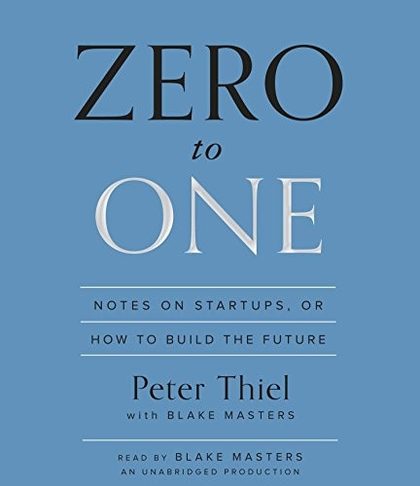
Review
I read this because it kept being cited, and it's a stronger book than its reputation as a founder-culture artefact suggests, provided you separate the argument from the politics around it.
The useful distinction is between going from nothing to something and going from something to more of it. Most work, including most work called innovation, is the second kind. Copying a proven model to a new market is valuable and it isn't the same activity as making a thing that did not exist, and conflating them lets teams believe they're doing something more novel than they are.
The argument about competition is where it gets genuinely provocative. He treats competitive markets as a trap rather than a proof of demand, and monopoly as the goal rather than the accident. I think he overstates it considerably, and it still improved how I evaluate a market. If your differentiation is that you'll execute better in a crowded space, that's a bet on stamina, not on position.
The parts that have aged least well are the contrarian-question posturing and the confidence that the author's own track record generalises. Read it for the market-structure thinking and hold the rest at arm's length.
Key Takeaways
The parts worth keeping:
Zero to one, or one to n
- Creating something that did not exist is a different activity from copying something that works into a new place. Both can be good businesses; only one is invention.
- Globalisation spreads existing things. Technology makes new ones. Confusing them makes teams overestimate how novel their work is.
Competition is not a compliment
- A crowded market proves demand and also guarantees the margin goes to customers rather than you. Being in a fight is not evidence you picked well.
- The goal is a position where you are the only reasonable choice for a specific group, not where you are marginally preferred among many.
- Companies in competitive markets describe themselves narrowly to sound dominant. Companies with real positions describe themselves broadly to avoid attention. Listening for which one a pitch is doing is informative.
Start small on purpose
- Take a small market you can genuinely dominate, then expand outward into adjacent ones. Starting broad means competing everywhere and owning nowhere.
- The small market has to be a real one, with people who badly need the thing, not a slice defined so narrowly that it contains no demand.
The uncomfortable questions
- What do you believe that most people you respect would disagree with? Applied to a market rather than to yourself, it's a useful filter for whether you have a thesis at all.
- Distribution deserves the same design attention as the product. A better product with no route to its customers loses to a worse one that has a route.
- Definite optimism, having a specific plan for a better future, beats vague optimism that things will work out. Most roadmaps are the vague kind.