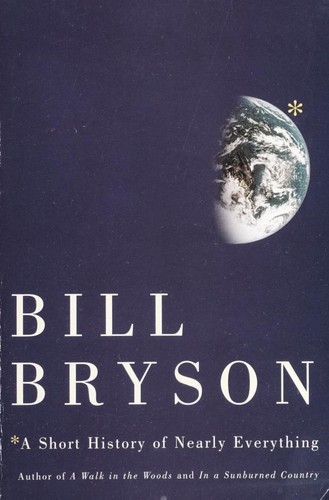
Review
This has nothing to do with my work and it is one of the more enjoyable books I have read, so it stays on the shelf.
Bryson set out to understand the science he had ignored at school and wrote up the journey, which turns out to be the right format. The book is as much about the people as the physics: the rivalries, the accidental discoveries, the number of important findings made by someone with no formal standing who happened to be looking carefully.
What I actually took from it is a better sense of how knowledge accumulates. Almost nothing arrived through a single insight. Ideas were proposed too early and ignored, or held by someone who never published, or fought over for decades before the evidence settled it. That's a useful corrective if you spend your time in a field that talks about breakthroughs constantly.
It has aged in places, being over twenty years old, and some sections have been superseded. Bryson is also a generalist writing about specialists, which shows occasionally. Neither matters much. Read it for pleasure and for the reminder that most expertise is narrower than it appears from outside.
Key Takeaways
The parts worth keeping:
Discovery is messier than the story
- Almost nothing arrived as a single flash. Ideas surfaced too early, sat unread, or were fought over for decades before evidence settled anything.
- A striking number of significant findings came from people outside the establishment who were simply paying close attention.
- Being right is not sufficient. Being right, published, and believed by the relevant people is a much longer road.
Measurement is the hidden protagonist
- An enormous amount of scientific history is people working out how to measure something nobody could measure before.
- The instrument usually arrives before the insight, and determines which questions are even askable.
How much rests on very little
- Several foundational numbers were established by a small number of people with improvised equipment, and then relied on completely.
- Some accepted figures were substantially wrong for long periods, with nobody in a position to notice.
Why it is worth a product person's time
- It is a long argument against the great-insight narrative, which is the one our industry tells most often about itself.
- It is also a reminder that expertise is narrow. The specialists in the book are frequently wrong the moment they step outside their area, confidently.