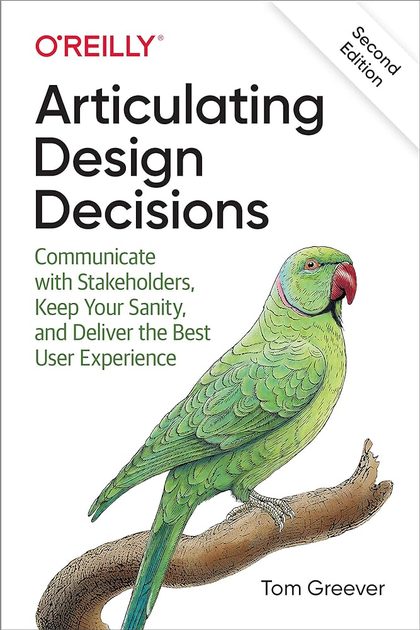
Review
I've spent enough of my career defending product decisions in front of skeptical stakeholders to know that being right about the design is the easy part. The hard part is getting someone with authority and limited context to agree with you, in real time, in a meeting they probably weren't looking forward to. This book is the best thing I've read specifically about that problem.
It's written for designers, but the audience should be broader. Product managers, researchers, anyone who produces work that needs sign-off from someone senior enough to override it will recognize the dynamics Greever describes. You have more context than the person with the final say. Closing that gap is your job, not theirs.
The insight that stayed with me most isn't a framework. It's the reframe that you're not in the room to win. You're there to create conditions where agreement becomes easy. That changes the entire shape of preparation: what to remove before the meeting, what objections to rehearse, who to have onside before anyone sits down. The book treats a design review as a design problem in its own right. That's the right way to think about it.
Greever is honest about the uncomfortable reality that someone can always overrule you, and that arguing harder isn't the answer. The answer is to have built enough trust, over time, that your recommendation carries weight before the room fills. Good design requires good politics. Not as a compromise. As part of the craft. I've come to believe that's true.
Worth it for designers and PMs alike.
Key Takeaways
The parts worth keeping:
What a stakeholder is silently asking
Every person in the room is running three questions in the background, whether they say so or not:
- What problem does this solve?
- How does it affect the user?
- Why is this better than the alternative?
If your explanation doesn't answer all three, someone in the room will fill the gap with their own assumptions. The meeting can go wrong before you've said anything incorrect.
Before the meeting
- Remove anything that will attract the wrong kind of attention: placeholder copy, rough edges, unfinished details. They become the conversation instead of your design.
- Write down every objection you expect to hear. Write your response to each one and say them out loud. For anything high-stakes, this step isn't optional.
- Bring alternatives, and be ready to explain why you rejected them. Showing you considered other directions is as persuasive as the design itself.
- Find at least one person who already agrees with your direction and make sure they're in the room.
In the meeting
- Let people finish before you respond. You can't reframe a concern you haven't actually heard.
- When someone proposes a different direction, ask what problem they're trying to solve. The suggestion is noise. The problem beneath it is the signal.
- Use their language, not yours. Match their vocabulary: if they say customer, say customer. It signals you're paying attention.
- Redirect personal preference to functional questions. Whether someone likes it isn't actionable. Whether it works for the user is.
Handling common objections
- They say it doesn't feel right. Usually missing context about why the decision exists. Walk through the three questions and rebuild the rationale from scratch if needed.
- They say they'd have done it differently. An authority assertion, not a design critique. Acknowledge it, then tie back to the problem being solved and the user impact.
- They suggest an alternative direction. Ask what problem that alternative would solve. The suggestion is the surface; the concern beneath it is what you need to address.
- They say they don't like it. Something feels off but they can't name it yet. Ask what specifically isn't working and shift the conversation from preference to function.
Mindset
- Someone can always overrule you. Arguing harder isn't the answer. Building trust over time, so your recommendation carries weight before the meeting starts, is.
- Lead with agreement. Starting from yes makes difficult feedback land differently than starting from defense.
- Bank account of trust: accepting a bad decision today builds the credit you need to win the next one. Sometimes the right call is to let it go.
- Good design requires good politics. That's not a compromise. It's part of the craft.
After the meeting
- Send your notes quickly, before memories drift and the narrative gets rewritten.
- Where something remains unclear, make a decision and communicate it. Silence doesn't create space. It creates confusion.