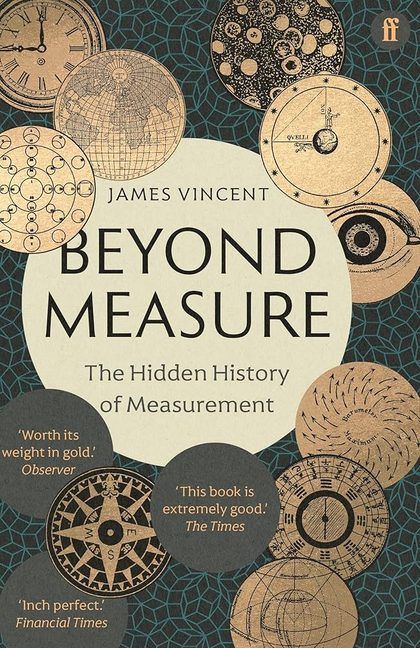
Review
A decent chunk of my job is deciding what to measure and being able to defend the choice. I went into this book expecting a working playbook for that. What I got instead was several thousand years of how humans agreed on the length of a foot.
The history itself is well told: Roman land surveys, the French Revolution reinventing the metre, a kilogram now defined by Planck's constant and a cesium clock. Interesting stuff, but none of it sharpened how I think about product metrics on a Monday morning.
Too much of the book is trivia dressed up as insight. The parts that do transfer, like the idea that precision reveals noise rather than removing it, are worth extracting. There just isn't enough of them to carry 300 pages.
Read it for the history. Skip it if you want to get better at measuring product outcomes.
Key Takeaways
The parts worth keeping:
What statistics and blackboxing add
- Statistics let measurement work at scale, because individual errors cancel out instead of stacking up, and regression and correlation can turn a handful of shallow readings into a real signal.
- Peirce's fallibilism: no fact is beyond doubt, and science is just the most reliable method we have for producing provisional knowledge. That's not a weakness in the method, it's the whole point of it.
- Blackboxing: once a method works reliably, people stop asking how it works and only the input and output stay visible. That builds authority fast, and it hides every assumption baked into the process along the way.
Measurement as a tool of power
- Measurement underwrites three things at once: science, statistics, and the ability to govern. Remove it from any one of the three and the whole structure stops working.
- Changing a measurement system is never just technical, it's political. The metric system arrived out of the French Revolution. Rome held its empire together partly by standardizing weights and measures across it.
- People adopted shared measurement because it was useful, for trade, construction, and setting expectations, not because a ruler decreed it. Utility earns trust before authority does.
- Surveying land has always doubled as a claim on it. Rome gridded Europe. Cromwell used Gunter's Chain to survey Ireland. Jefferson used the same tool to carve up the American West. Measuring a place is often the first step to controlling it.
From body parts to Planck's constant
- Early units, feet, cubits, handfuls, get dismissed as crude. They weren't. They were portable, human-scale, and available to anyone without needing an external reference.
- The metric system tried to root measurement in nature rather than a king's foot or a merchant's habit, on the idea that a standard grounded in physics outlives any ruler. That premise still underpins every SI unit today.
- The modern kilogram is defined through Planck's constant, the speed of light, and a cesium oscillation, and comparing it precisely requires a vacuum chamber and a correction for the moon's gravitational pull. Something as ordinary as weighing an object rests on genuinely strange physics.
Why measurement is harder than it looks
- Choosing what to measure is an act of exclusion. Every measurement isolates one variable and throws away the rest, and that choice matters more than the number itself.
- A measurement only counts if it clears three bars: you can find the reference standard (accessibility), the scale fits what you're measuring (proportionality), and repeated results agree with each other (consistency). Fail any of those and you have an opinion dressed up as data.
- Trust in a measurement depends on tracing it back through an unbroken chain of comparison to the original standard. Break the chain, and the number stops meaning anything.
- Precision is not the same as certainty. The sharper the instrument, the more noise you find, not less.