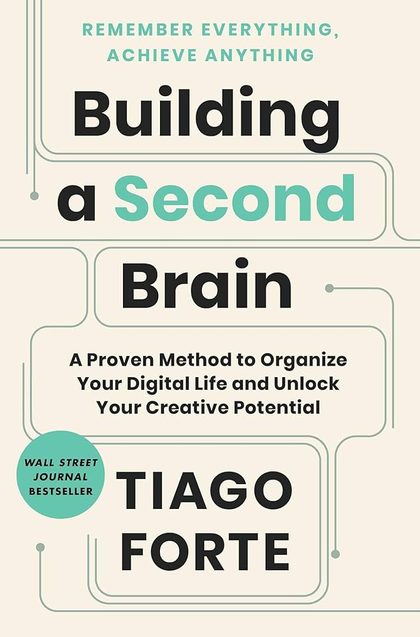
Review
I was skeptical of the title before I opened the book. It sounds like recruitment material for a productivity cult. The book earns it.
Tiago Forte has clearly thought longer and harder about personal knowledge management than most people, and it shows. CODE (Capture, Organize, Distill, Express) is a well-designed framework: tight enough to be memorable, flexible enough to survive contact with how people actually work.
The idea that changed my thinking was intermediate packets. Work isn't a sequence of tasks that end when you deliver. It's a stream of reusable components: distilled notes, draft sections, diagrams from a project completed last year. Every one of those is a building block. I had been treating them as disposable. After finishing this book, I stopped.
The book is more prescriptive than it needs to be in places. Tiago wants you using specific tools and following specific ratios. The underlying logic holds up regardless of which tool you use. Treat the implementation details as suggestions.
Key Takeaways
The parts worth keeping:
The CODE method
| Step | What to do | Why it matters |
|---|---|---|
| Capture | Save what resonates, surprises, or feels personally relevant | About 10% of what you read deserves saving; filter ruthlessly from the start |
| Organize | Sort into PARA by actionability, not by topic | The question isn't what category but when you will need it |
| Distill | Compress notes to the essential; extract before you need them | Volume without distillation creates clutter, not knowledge |
| Express | Ship the work; share what you know | If you never express, everything else is just filing |
PARA: organize by actionability
| Bucket | What belongs here | Key distinction |
|---|---|---|
| Projects | Active work with a deadline and a specific outcome | Has an end; you know when it's done |
| Areas | Standards and responsibilities to maintain over time | Ongoing; no finish line |
| Resources | Topics of future interest with no current project attached | Not active yet; could become a project |
| Archives | Completed, paused, or dropped items | Inactive but searchable when you need them again |
Progressive Summarization
Apply in passes, not all at once. Each layer takes more effort and earns a smaller audience:
- Save the relevant bits. Capture the section that caught your attention, not the whole article.
- Bold the important parts. On re-reading, bold the sentences that actually matter.
- Highlight the best of the bold. On a third pass, keep only the lines you would quote or act on.
- Executive summary. Only if the note earns it: one or two sentences at the top. Most notes never need this layer.
The result is that you can skim at the right depth without re-reading everything. You layer context forward for your future self rather than hoping you remember.
Intermediate packets
- Think of your work as reusable components: distilled notes, outtakes from past projects, in-progress drafts, reference material from others. Each packet is a building block, not a dead end.
- Packets are robust to interruption. You're always working on something small enough to finish. You make progress in the gaps. Quality improves because you can share and get feedback more often.
- When you start a new project, begin by assembling existing packets. The more you have accumulated, the faster you start. Eventually a whole project becomes an act of assembly rather than creation from scratch.
Capture discipline
- Capture about 10% of what you read. Value isn't evenly distributed. Be a picky curator, not a collector.
- Define up to 12 problems you want to solve and use them as a permanent filter for what you save. Without a deliberate filter, everything seems worth capturing. The 12 problems make the decision automatic.
- Separate capture from organization into two distinct steps. Push everything to an inbox first. Friction at the point of capture kills the habit before it can form.
- Stigmergy: leave marks for your future self. Every well-captured note makes the next task easier, the same way trail-marking works in nature. Your system compounds through consistent small acts, not through a single perfect setup.