Review
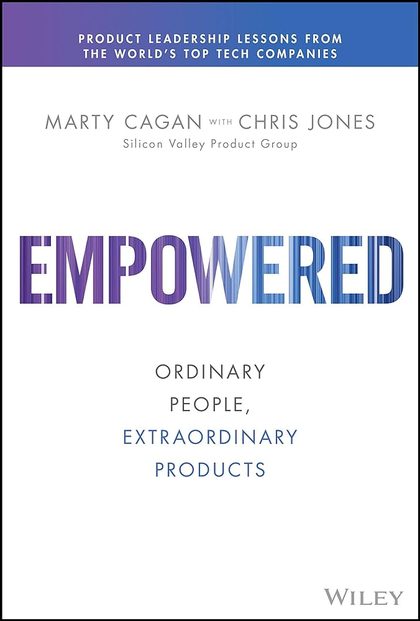
I was three years into managing product managers when I picked this up. Inspired had shaped the way I thought about the PM craft; Empowered addressed something harder to find: a clear account of what leaders actually need to do to make empowered product teams work.
The book covers eight domains a product leader controls: coaching, staffing, product vision, team topology, product strategy, team objectives, business collaboration, and transformation. Cagan and Jones don't package these into a prescriptive framework. They lay out considerations for each domain and let you work out the right application. That restraint is worth noting. It's why this book holds up better than most product books, which age badly once the methodology or tool they center on falls out of fashion.
What landed hardest for me was the strategy section. Most organizations I have worked in don't have product strategy. They have roadmaps assembled by whoever shouted loudest during planning. The book names that pattern directly and is specific about what real strategy requires: insight, focus, and active management by product leadership rather than delegation to a planning process.
Recommended for product leaders and senior PMs who already know the Inspired canon. If you haven't read Inspired, start there first.
Key Takeaways
The parts worth keeping:
Coaching
- Developing people is the primary job. You're not there to manage deliverables. Create an environment where people own outcomes, not tasks. Stretch people just beyond their comfort zone.
- Use the three-pillar assessment to gap-analyze your team: rate current capability against expectations on a 1 to 10 scale across Product Knowledge, Process Skills, and People Skills. Limit any coaching plan to three focus areas.
| Product Knowledge | Process Skills | People Skills |
| User and customer | Discovery (risks and research) | Team collaboration |
| Data | Optimization (rapid iteration) | Stakeholder collaboration |
| Market, domain and industry | Delivery | Product Evangelism |
| Business, company and stakeholder | Product Development | Leadership Skills |
| Operational (can demo and support) |
- The 1:1 exists to develop people, not gather status. Weekly, minimum 30 minutes. Coach them to think in outcomes, risks, and holistic problem-solving. Provide strategic context every time.
- Collaboration isn't consensus, artifacts, or compromise. The goal is to find something valuable, viable, feasible, and usable. Everyone does their homework and relies on others to have done theirs.
- Customer centricity means a minimum of three hours of real customer interactions per week. Keep the term customer precise. Never apply it to a stakeholder.
- Impostor syndrome is common and mostly healthy. Channel it into preparation: homework, studying, writing, rehearsing, iterating. The response to feeling inadequate is to prepare harder.
- Ethical risk is the fifth risk alongside value, usability, feasibility, and viability. Product teams sit at the leading edge of what gets built. Speak up. Anchor in the best interests of the company.
- The written narrative forces clearer thinking. Write a few pages explaining your argument and recommendation. Anticipate objections. Test it with people who will tell you the truth. Then make the deck.
- Empowered teams need enough context to make good decisions without asking permission.
| Company Mission | Purpose of the company. Why we are here. |
| Company Scorecard | Critical KPIs. |
| Company Objectives | Focus for the year. Should be outcomes, not outputs. |
| Product Vision | The inspiring, tangible future we are trying to create, 3 to 10 years out. |
| Product Principles | Values and beliefs that guide decisions in support of the vision. |
| Team Topology | What each team is responsible for. |
| Product Strategy | Connects teams with product vision and company objectives. |
Staffing
- Trust is competence plus character. Competence is capabilities, skills, and track record. Character is integrity, motive, and intent. Both are required.
- Don't hire for cultural fit. That means hiring people who look and think like you. Hire for character. You want people who think differently.
- Recruiting is active work. Build your network continuously. If you need to hire, spend 50% of your time on it until it's done.
- Don't hire for domain knowledge. A great PM will learn the domain before a mediocre one learns to be great. Move quickly to offer: within 24 to 48 hours.
- Onboarding has four checkpoints: 1, 7, 30, and 60 days. Make an assessment and a coaching plan immediately. Get new people in front of customers as fast as possible.
- People join a company but leave their manager.
Product Vision and Principles
- A compelling product vision keeps focus on the customer, creates a common north star, inspires people to create extraordinary products, gives work meaning, leverages industry trends, clarifies architecture decisions, drives team topology, and works as a recruiting and evangelism tool.
- Make the vision customer-centric, ambitious (3 to 10 years out), and grounded in real trends, not tech for its own sake. A visiontype communicates more than a slide deck.
- You can validate demand for the vision. You can't validate the solution yet. The vision is a bet on yourselves that you will find the answer.
Team Topology
- Balance three interrelated goals: ownership (meaningful scope, deep understanding, tradeoff authority), autonomy (solve problems how the team sees fit, minimize inter-team dependencies), and alignment (boundaries track with architecture, business units, and customer types). These three goals trade off against each other.
- Platform teams do the difficult specialized work so experience teams don't have to. In large organizations, up to half of all teams may be platform teams.
- Experience teams are most empowered when given as much end-to-end responsibility as possible. A team that owns only a slice of the experience has to coordinate with everyone else to ship anything meaningful.
- Design is too important not to be part of the product team. The internal design agency model fails because the designer is absent when key decisions are made.
- Warning signs that topology needs work: developers frequently shifted between teams, too many dependencies, teams with limited scope of ownership, engineers dealing with complexity outside their area.
Product Strategy
- Product strategy is deciding which problems empowered teams should solve. It's not a list of features or projects. Most companies don't have strategy. They have stakeholders buying roadmap slots and leaders unwilling to make hard choices.
- Focus is the hardest part. WIP limits work. Every high-priority initiative costs leadership attention, and that cost compounds.
- Insights come from four sources: quantitative data, qualitative research (evaluative and generative), technology shifts, and industry analysis. Share learnings as you go, because leaders are often given the information they ask for, not the information they need.
- Turn insights into action by assigning problems to teams, not features. OKRs are one mechanism. The real requirement is a leader who sits down with each team, explains the strategic context, names the problem, and defines success in business outcomes.
Team Objectives
- OKRs fail in most organizations for three reasons: they clash with feature teams that can't define outcomes, managers set individual objectives that compete with team objectives, and leadership steps back when they should be more engaged.
- Three prerequisites: move to empowered product teams, shift from individual to team objectives, make leaders turn strategy into problems for teams to solve.
- Give each team a qualitative objective and 2 to 4 key results defined as business outcomes. Let the team define the numbers as part of an informed negotiation. One primary measure, plus guardrail measures.
- Make the level of ambition explicit. Roof shots are low-risk incremental improvements. Moon shots aim for 10x with high risk. A team might build a portfolio of bets and attack a problem from multiple angles.
- High-integrity commitments are binary: delivered or not. Commit only after discovery is done. Reserve them for external or very substantial internal commitments.
- Accountability is the companion to empowerment. Teams are given space to find solutions in exchange for genuine responsibility for results.
Business Collaboration
- The shift from feature teams to empowered product teams begins with trust. That trust is easier to build when the product leader is a genuine peer to the other executives and has a real relationship with the CEO.
- Feature teams serve the business. Empowered product teams serve customers in ways that also work for the business. Treat stakeholders as partners, not clients.
- Product leaders evangelize: use prototypes, share customer pain, share the vision, share learnings, give credit generously, learn to give a great demo, do your homework, be genuinely excited.
Transformation
- Four steps to meaningful transformation: get senior leaders to understand technology as an enabler, not a cost center; get strong product leaders in place; let them recruit and develop the staff needed for empowered product teams; redefine the relationship with the business.
- The empowered model should cost less, not more. Less waste means fewer things built that nobody needed.