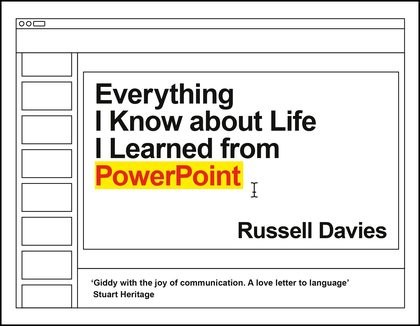
Review
Presenting well looks effortless and isn't. This book is a reminder that the polish comes from preparation, not talent.
I'd genuinely like to have watched Russell Davies present in person. Public sector work, of all places, is apparently where his presentations stood out.
The writing does some of the teaching itself. Get a few chapters in and you can feel your own copywriting tightening up just from proximity to his sentences.
None of this comes from some universal authority, his included. It's a pile of things that worked for him, written with more confidence than he actually claims to feel. Do the prep anyway. You owe the room that much.
Key Takeaways
The parts worth keeping:
Mindset
- Almost everyone can become a good presenter. There is no single mold, find your own version of great.
- Talk about what you actually know.
- Don't aim for brilliance. Get the basics right and you're already ahead of most people.
- Think of each slide as a poster, not a page of a document.
- Getting one idea out of your head and into someone else's is already close to a miracle. Don't be subtle about it.
- If you want someone to present well, give them time to prepare. That's on you as much as them.
Structure
- Beginning, a three-part middle, ending. Start with a story, close with an ask. A strong start and finish forgive a messy middle, so don't torture yourself trying to build one perfect narrative through the whole thing.
- Write the ending first. Once you know where you're landing, the beginning gets easy and the middle just has to earn the ask.
- People judge a presentation by its most intense moment and by how it ends, the peak-end rule. Either tell them the ending upfront, or tease it and reveal it at the close.
- Three ways to close well: finish earlier than expected, play back a quick summary of every slide, or get the room to clap (a genuine thank-you slide usually does it).
- The most common mistake is cramming too much onto a slide. Fix it by cutting, not by shrinking the font. Write down what you're deliberately choosing not to cover.
- Use threes and lists. Reveal points one at a time rather than dumping them all at once, and favor odd numbers, top 11 beats top 10.
- Repeat the things that matter. Decide whether you're going for clear and catchy or unpredictable and magical, and commit to one.
- A genuinely useful constraint: sketch each slide on a plain business card with a sharpie first. The size forces the structure.
Writing and visual style
- Headlines, not headings. "Murderer on the loose" beats "Today's News."
- Short, big, clear words. Strong verbs, short sentences, the occasional rhyme or bit of alliteration.
- Cut the corporate b-list words: key, holistic, engagement, evolve.
- Alternate long and short sentences to create rhythm.
- A slide is a unit of thought. Three bullets maximum, six words a line maximum.
- Make it bigger than feels necessary: big type, minimal color and font variation, one thing to look at per slide.
- Type at 30pt, serif, left aligned, sentence case, high contrast. Simple charts only, no 3D, no pie charts, no animation.
- Start every deck in black and white before you add any color at all.
- Never copy-paste text in. That's exactly how corporate jargon gets in.
Before and during
- Rehearse the way a stand-up comedian workshops a set. What looks spontaneous on the day is usually the product of dozens of run-throughs. Steve Jobs reportedly spent three months refining his biggest keynotes.
- Rule of thumb: an hour of preparation for every minute on stage.
- On the day: arrive early, be kind to the AV people, double-check the tech, and have an actual plan for what happens if your slides fail.
- Don't read off the screen. Talk like you're sharing something you found with friends.
- Build a personal opening you can reuse across talks, something small to settle your own nerves as much as the room's.
- Vary your pace deliberately: slow down, speed up, pause.
- Cap yourself at 20 minutes. If you need longer, split it with a break. If you're going to miss your time, finish early rather than late.
Quotes worth keeping
A cash point gives you cash. A PowerPoint gives you power.
Make it big, keep it short, have a point.
Creative industries are full of people who remove things dispassionately and expertly from other people's work.
Use words. Not too many. Mostly short.
Strategy is like food: how it looks matters.