Review
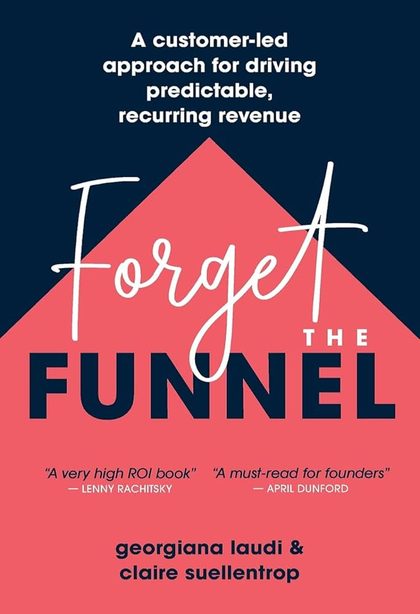
Forget the Funnel gave me a framework I actually want to put into practice. The premise is straightforward: a company is a value exchange, you create value for a customer and then capture a share of it back. Laudi and Suellentrop build something more useful than the traditional marketing funnel by anchoring it to what your best customers actually experience, not generic funnel stages.
It complements Jobs to Be Done thinking rather than competing with it, which made it easy to slot into research work I already do. What stood out most is the focus it forces. In my experience, teams stall from a lack of focus more often than a lack of ideas, and the Customer-Led Growth model makes you commit to one job, one gap, one KPI at a time instead of spreading effort across everything at once.
Key Takeaways
The parts worth keeping:
- The problem: marketing and product teams throw ideas at the wall without really knowing their customers, which is guessing dressed up as strategy.
- The solution: research your best customers deeply enough to understand their life before your product, what pushed them to look for something new, why they chose you over the alternatives, and what changed for them afterward.
- The Customer-Led Growth framework has three steps: get inside your best customers' heads, map and measure their experience, then unlock your biggest growth opportunities.
- The traditional marketing funnel (awareness, consideration, purchase) doesn't fit a recurring-revenue business that needs customers to keep paying month after month. Reaching, resonating with, and retaining the right customers depends on understanding their psychology, not moving them down a funnel.
- This only works with buy-in from a cross-functional team and real ownership. Vague goals and unclear accountability are what create the dysfunction the framework is meant to fix.
Finding your best customers
Not every customer is worth learning from. Your best customers understand the problem your product solves, have personally struggled with it, pay without hesitation, have an ongoing need for it, and have reached what the authors call value realization: they've actually solved the problem they came for. Ideally they signed up recently enough (three to six months back) that they still remember what life was like before you.
If you have 500 or more of them, survey. Fewer than that, or only time for one method, interview. Either way, don't take what customers say at face value. Look for the psychology behind it, the pains and needs driving their answers, not just their stated opinions. Useful questions to build from: what was life like before you, what made the old way stop working, where did you look, why did you choose us, and what can you do now that you couldn't before.
No existing customer base to learn from? Do audience research instead: study the conversations your target customers are having in forums and communities, the language they use to describe their pain points, and the other solutions they've tried and rejected. Treat what you learn as a hypothesis to prove, not a fact, since you don't yet know these people are a fit.
Jobs to be done
The customer job statement compresses the research into one sentence: when I [struggle], help me [motivation], so I can [desired outcome].
Getting there takes four steps: pull the struggles, motivations, and desired outcomes out of your research; look for common themes across them; draft a job statement for each theme; then prioritize a single job to focus on, weighing urgency, willingness to pay, retention and expansion potential, and how well it fits where your product and team already are.
Mapping the customer experience
Once you know the job, break the customer's experience into three phases: Struggle (they realize they have a problem and start looking for a fix), Evaluation (they try your product and decide it's the answer), and Growth (they embed it into daily life and their needs keep evolving). Each phase usually splits into two or three milestones, tracked by what the customer is thinking, doing, and feeling at each one, for example Problem and Interest inside Struggle, or Continued Value and Value Growth inside Growth.
A generic engagement metric like daily or monthly active users tells you activity happened, not whether the customer got value. Give each milestone its own KPI instead: a specific, trackable action that proves the customer has actually crossed it. Here's the kind of ladder that produces:
| Phase | Milestone | Example KPI |
|---|---|---|
| Struggle | Problem | New unique website visitors |
| Struggle | Interest | First search |
| Evaluation | First value | 5+ searches and 1+ list |
| Evaluation | Value realization | 10+ searches, 2+ lists, 2+ exports |
| Growth | Continued value | Monthly 10+ searches, 2+ lists, 2+ exports |
| Growth | Value growth | Monthly 10+ searches, 2+ lists, 2+ exports, plus an upgrade, review, or referral |
A success gap is the point in the map with the biggest drop-off between what your ideal customer needs and what your current experience actually delivers. Pick the gap that would have the biggest payoff for the least new effort, put the team's ideas on the table for closing it, then use the new KPI to track whether it worked.
Putting it into practice
- Share the research and the map widely, an all-hands works well. Show the data, name the contributors, and explain how the map will actually be used.
- Use it to guide planning cycles, individual projects, team targets, dashboards, and even onboarding, so it becomes how the organization thinks about customers, not a one-off deck.
- Once one job is served well, go back and repeat the process for a job you tabled earlier, or a customer segment you don't currently serve.