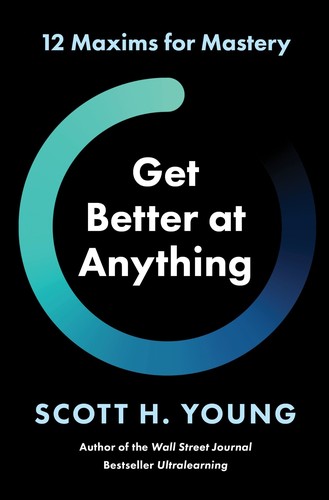
Review
Young's argument is that improvement needs three things and that most people are missing one of them without realising which.
You need to see how others do the thing, you need volume of actual practice, and you need feedback that tells you what to change. Plateaus happen because one of the three is absent, and the useful move is diagnosing which rather than simply trying harder at whatever you were already doing. That framing is simple enough to apply to yourself in about a minute, which is more than most books in this category manage.
The section I found most interesting is on copying. He makes the case that watching how experienced people work is undervalued because we romanticise originality, and that most fields improved fastest when practitioners could observe each other. In software this is the argument for reading other people's code and pairing, which everyone agrees with and few do systematically.
The research is handled well and not oversold, which distinguishes it from most of the genre. My reservation is that the three-part model is broad enough to explain almost any plateau after the fact, and a framework that always has an answer is worth holding loosely.
Key Takeaways
The parts worth keeping:
Three inputs, and you are probably missing one
| Input | What its absence looks like |
|---|---|
| Seeing | Reinventing solved problems, unaware of how others do it |
| Doing | Plenty of theory, very little accumulated practice |
| Feedback | Years of experience repeating the same errors confidently |
- Diagnose which one is missing before adding effort. Adding more of what you already have is the usual response and rarely the fix.
Copying is underrated
- Observing how skilled people actually work is one of the fastest routes to improvement, and it is culturally undervalued because we prize originality.
- Fields advance quickest when practitioners can watch each other. Where the work is hidden, everyone rediscovers the same things slowly.
- Originality tends to come after fluency, not instead of it.
Practice has to resemble the real thing
- Skill transfers less than people expect. Practising a simplified version produces someone good at the simplified version.
- Difficulty during practice is often a sign it is working. Conditions that feel smooth usually indicate you are rehearsing what you can already do.
Feedback quality decides the ceiling
- Feedback needs to be specific and soon enough to connect to what you did. Vague or delayed feedback teaches almost nothing.
- Some fields supply it naturally and some actively hide it. In the second kind you have to construct it deliberately or you will plateau early and not notice.