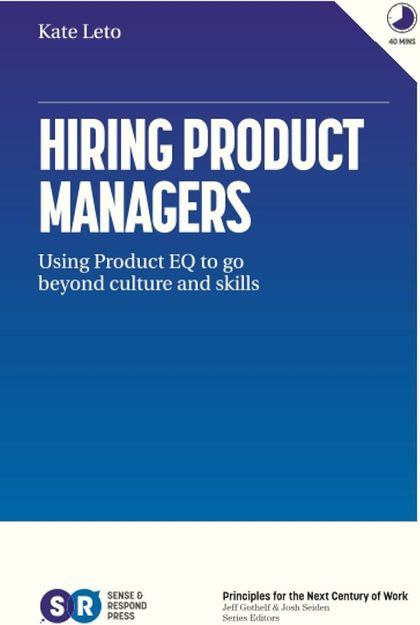
Review
I have hired product managers. The most common failure isn't a skills gap. It's someone technically solid who can write a sharp spec but falls apart when the job actually requires them to align a skeptical leadership team or navigate a politically charged prioritization conversation. Kate Leto names that gap directly: human skills matter as much as technical skills, and most hiring processes underspecify what a PM actually needs to do in the room.
The strongest thing in the book is the role canvas. Building a job description from a cross-functional workshop rather than copy-pasting the previous spec sounds obvious. It's not. The teams I have seen work through this arrive at a genuinely different kind of specification: one that captures what the person needs to achieve rather than just what they need to have done before. Pair that with the human skills framing and you get a process that selects for the PM who can do the actual job, not just describe it on a CV.
Where the book doesn't earn its length is the closing stretch on continuous iteration of the hiring pipeline. Retrospectives after a hire, iterating on interview questions, sensing and responding through the process: all reasonable ideas, none of them developed enough to be actionable. The book reaches its core insight early and then doesn't know quite where to go next.
Right diagnosis, incomplete prescription. Worth reading for the human skills framing and the role canvas; stop expecting it to go further than it does.
Key Takeaways
The parts worth keeping:
Define the role before you post it
Run a cross-functional role creation workshop. Build the canvas as a group before anyone opens a job description template.
| Dimension | What to define |
|---|---|
| Purpose | Why does this role exist? |
| Accountabilities | What goals or outcomes will this person own? List what is known now. |
| Human Skills | Leadership, conflict resolution, influence, adaptability |
| Technical Skills | Roadmaps, design sprints, product vision, JTBD, OKRs |
- Translate the canvas into the job description. The canvas is the source of truth; the JD is the public-facing version of it.
- A well-written job description reveals how a company actually thinks about a role. Write it badly and it filters for the wrong people before a single interview happens.
Balance human and technical skills
- Technical skills cover what a product person does: ideation, creation, delivery, iteration. They are necessary. They aren't sufficient.
- Overindex on technical skills and you build a team that can execute but can't navigate the organizational conditions that make execution count.
- Emotional intelligence is the human-skills anchor. Leto uses four dimensions from Goleman:
| Dimension | What it means |
|---|---|
| Self-awareness | Knowing what you're feeling and why. Supports intuition and decision making. |
| Self-management | Handling distressing emotions and staying connected to positive ones. |
| Social awareness | Reading the feelings, needs, and concerns of the people around you. |
| Relationship management | Making relationships positive and productive for both parties. |
Interview for intentions, not just outcomes
- Behavior-based questions reveal the intentions behind what a candidate accomplished, not just the accomplishment itself. You want to understand why they made the decisions they made, and what the effect was on the people around them.
- Ask questions that relate to emotional intelligence specifically. The technical interview already covers the technical skills.
- Brainstorm questions as a group. After each interview round, iterate on the structure together.
After the interview, ask your panel three things:
- Did this candidate challenge your current thinking or process?
- Did they bring energy that's different from what is already in the room?
- Did you learn something new from talking to them?
Hire for contribution, not fit
- Cultural fit hires for similarity. Cultural contribution hires for difference that still aligns with the values. These aren't the same thing.
- Inherent diversity: gender, ethnicity, orientation. Acquired diversity: working in another country, building for customers unlike yourself, experiences that shaped your perspective in ways your team hasn't seen before.
- The goal is a team that looks like a puzzle, not a stack. Everyone different, everyone fitting together. A team of clones optimizes for agreement rather than outcomes.
- After making a hire, run a retrospective. What worked in the process? What would you change next time? Treat the hiring pipeline the same way you would treat a product.