Review
Holistic Product Discovery works as a reference book more than a manifesto. It pulls product discovery and delivery together into one place and does a genuinely good job summarizing the state of the theory, all while pointing you toward the other books and frameworks it's drawing from rather than pretending to have invented everything itself. It doesn't quite land a single unifying theory that ties discovery and delivery together, which is a real gap for a book positioned this way.
What I appreciated most is that it assumes you already know some product fundamentals, so it doesn't waste pages re-explaining the basics. That assumption buys it real brevity. Worth reading.
Key Takeaways
The parts worth keeping:
Why building the right thing is hard
A handful of biases quietly work against good discovery: confirmation bias (undervaluing facts that don't confirm what you already believe), optimism bias (assuming bad outcomes happen to other people), the IKEA effect (overvaluing what you built yourself), and the sunk cost fallacy (protecting past effort instead of the future outcome). Add unchallenged assumptions, siloed teams that only focus on execution, and the belief that more output automatically means more value, and you get a long list of reasons teams build the wrong thing confidently.
| Stage | What it's for | Currency |
|---|---|---|
| Discovery | Figuring out what to build, making sure it's worth building | Knowledge |
| Delivery | Building it, realizing the value | Value |
Rule of thumb: discovery should take roughly 10% of build time. Discovery isn't a phase you finish, it's a mindset you keep running.
Five principles worth internalizing
- Problem-first over solution-first: fall in love with the problem, not your first idea for solving it.
- Outcomes over outputs: shipping isn't the point, the impact is.
- Team diversity, trust, and psychological safety over individual effort: diverse teams innovate better and carry less risk.
- A holistic view over local optimization: look past your own discipline to what the whole company needs.
- Continuous discovery over unplanned exploration: in a complex domain the future is unknowable, so sense and respond rather than plan once and execute.
Three qualities every product needs
| Quality | The question it answers |
|---|---|
| Viability (business value) | Should we build it? Does it meet a real business goal or fit the strategy? |
| Desirability (user value) | Do they actually need it? Does it solve the problem efficiently for them? |
| Feasibility (practical reality) | Can we sustainably build it, with the skills, tech, and resources we have? |
The double diamond, made holistic
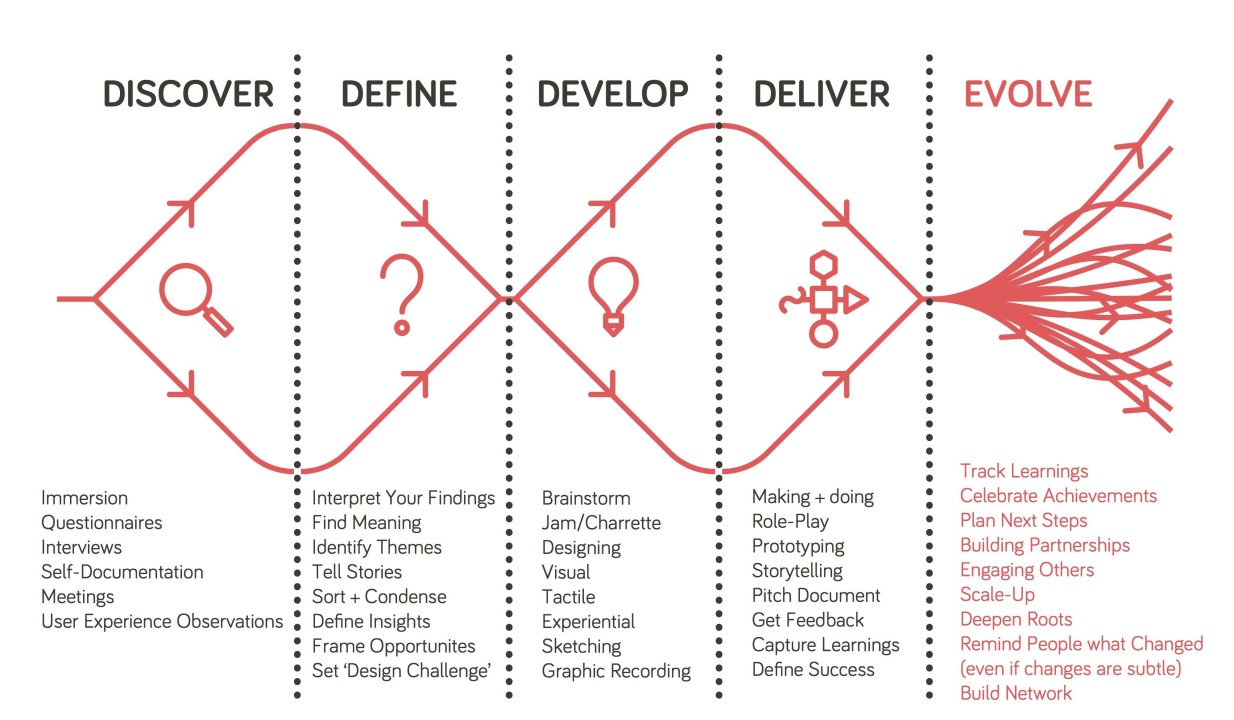
The book structures discovery around the classic double diamond: explore problems, structure problems, innovate solutions, validate solutions.
Its actual contribution is crossing that diamond with the three qualities above, so you're deliberately covering business value, user value, and feasibility at every stage rather than defaulting to whichever one your role happens to care about:
| Explore problems | Structure problems | Innovate solutions | Validate solutions | |
| Business value | What's the market landscape? | Where's the gap? | How could we exploit it? | Does the exploit deliver the intended outcome? |
| User value | What's the user's context? | What's their most important need? | What solutions could meet it? | Which solution meets it best? |
| Feasibility | What can we currently do? | What's our main practical opportunity? | What could we build? | What should we build, sustainably? |
Use several research methods per box, not one, triangulating across sources beats trusting any single one.
Two playbooks
For a known problem, run a tight loop: state a hypothesis (we believe customers have this problem, if we provide this solution we'll see this outcome), run a design studio to sketch and critique solutions as a group, build a prototype, test it on real users, then pitch it back to a wider group of stakeholders.
For an unknown problem, start wider: workshop the team's open research questions and cluster them, gather research from at least three sources (analytics, interviews, support tickets) to triangulate, run a design sprint to synthesize insights into something tangible, then pitch it to the wider group the same way.
Matching discovery effort to risk
Not every problem deserves the same amount of discovery. Four levels: no risk (obvious, go straight to delivery), low risk (complicated, use the playbook to mitigate it), medium risk (complex, iterate through holistic discovery), and high risk (complex enough that a wrong assumption kills the product, validate or invalidate it fast, lean startup style).
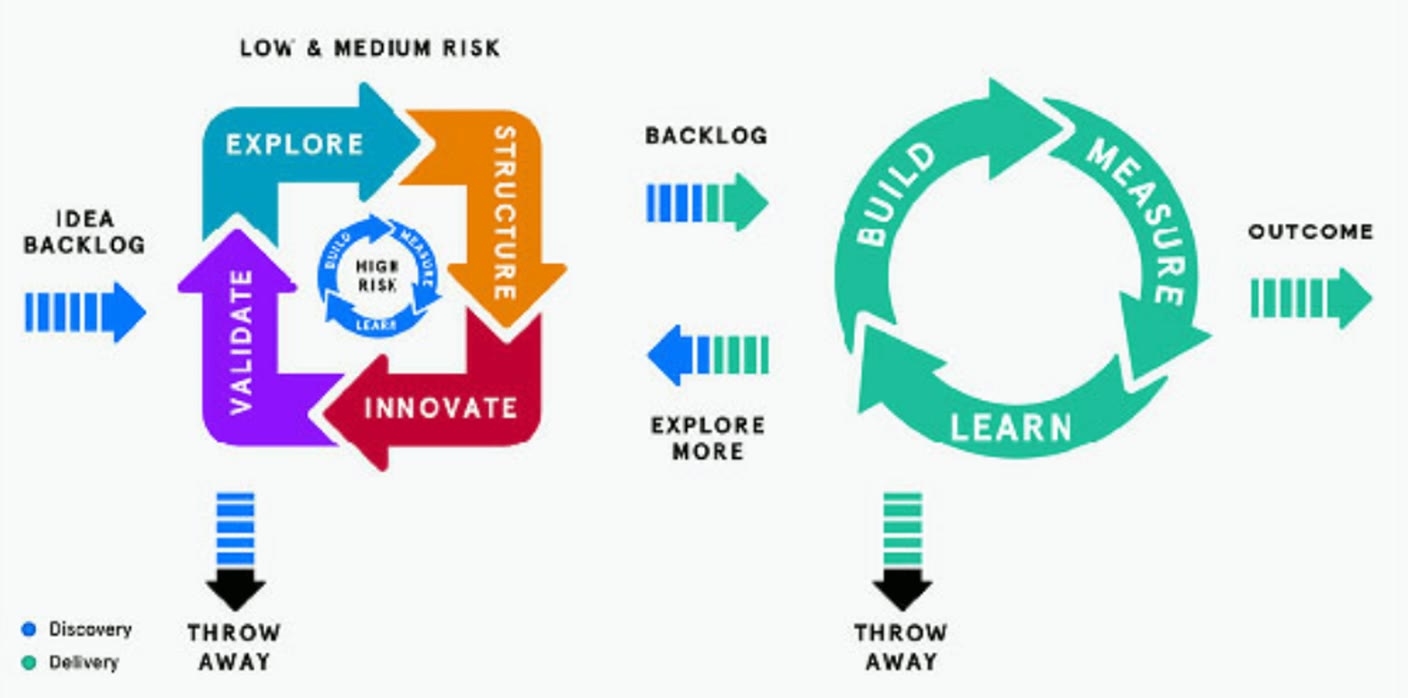
Discovery Kanban keeps this running continuously: always work the highest-priority item, and balance your learning rate against your development rate rather than letting one starve the other.
Getting the whole organization strategic about it
Set outcome-based, SMART goals for both business value and user value early, and keep checking them throughout, not just at the start. Tools like Opportunity Trees (Teresa Torres) and impact mapping help keep the goal connected to the work as it gets structured and prioritized. The same discipline applies to feasibility: know your current skills, what's going obsolete, what's emerging, and how the organization needs to change to keep up.
The biggest barriers to actually doing this well: no time or budget for it, no buy-in because the value is hard to prove upfront, the wrong people in the room, and no real access to users. Solve for transparency (make it visible where every discovery initiative stands) and most of these get easier: more discoveries make it into delivery, product and design relationships improve, and everyone starts speaking the same vocabulary.
Managing the change itself
Introducing any of this is itself a change project. Kurt Lewin's model is a useful shape for it: unfreeze (make the case that change is necessary), transition (make the actual changes, with people involved, not just informed), then refreeze (make it stick rather than snapping back). The Lippitt-Knoster model adds a diagnostic: change needs a goal, competence, motivation, resources, and an action plan all present at once. Miss the goal and you get confusion, miss competence and you get anxiety, miss motivation and you get resistance, miss resources and you get frustration, miss the action plan and you get false starts.