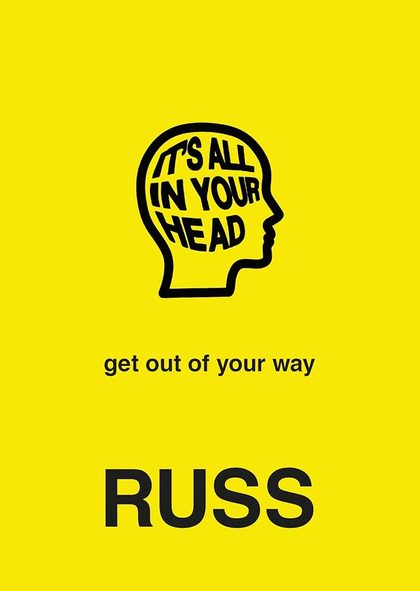
Review
I read this because 10 albums and 80 singles before breaking into the mainstream isn't a story about talent. Something else is doing the work, and I wanted to know what.
The central argument is that unshakeable self-belief was the engine, not skill, not connections, not timing. Russ frames confidence as a choice you make before you have any evidence to support it. That argument lands well in the first half. By the end, it starts to feel like a single note played a few too many times.
What actually transfers for me isn't the confidence chapter but the self-reliance chapter. Russ owned the whole stack: writing, production, video, marketing. He was told a single video would take two months, so he shot six in a day. That's product thinking: shorten feedback loops, own the means of production, remove the dependencies. The weekly single experiment is the same instinct restated. If you're not shipping regularly, you're not learning regularly.
The confidence argument is more inspiring than actionable. Believe in yourself is correct advice and also advice that doesn't tell you what to do on a Monday morning. The tactical chapters are thinner than I would have liked. But the book earns its read: it's short, honest, and specific enough about the actual choices Russ made that you leave understanding why it worked for him rather than just that it worked.
Worth reading if you're interested in creative persistence. Not if you want a replicable playbook.
Key Takeaways
The parts worth keeping:
On belief before evidence
- Russ spent a decade making music to an audience of almost no one. He calls this delusion, meaning the ability to believe when there's no external signal telling you to. That's a different thing from earned confidence; it's faith as a work input.
- He made public declarations before they were true. He tweeted $1m a beat in 2011. The framing matters: he treated the future state as already real rather than as a goal to chase.
- Confidence is a choice. That's the sharpest sentence in the book. Not a feeling you wait for, not a reward for progress made. A decision you make first and revisit every morning.
- He didn't acknowledge failures as failures. He treated them as steps on a path he had already decided led somewhere. Whether that's wisdom or a useful cognitive distortion, it kept him moving.
- Don't seek outside validation. The belief has to come from within, because external signals in the early years won't give you what you need to keep going.
On ownership and craft
- Self-reliance as infrastructure. Russ was writer, producer, rapper, video director, and marketer. He built a studio at home so the lights were always on. When you're not dependent on anyone to make something, you can constantly create.
- Study the ecosystem. He had a map of everyone in the industry on the wall. You can't expect to succeed if you don't know what worked and didn't work for the people before you.
- The weekly single experiment: switched from releasing albums to one song a week, each with its own artwork, for a full year. TuneCore earnings: June 2015 $600, June 2016 $102,000. Not an accident. A testable hypothesis run at volume.
- When told something would take two months, he did it in a day. Challenging the assumed constraint rather than accepting it's as useful in product work as in music.
- Never stop being a student of your game. The industry knowledge isn't optional decoration on top of talent; it's what turns output into traction.
On time and the work itself
- Trust the what, not the when. You can't put a deadline on success. Detach from when it happens. If you're too attached to the timeline, the gap between now and then becomes a reason to quit.
- Play for the love of the game, not the points. If you play for accolades and money and you get them, you stop trying. You need a motivation that doesn't run out when things go well.
- He loved the work enough to lose track of years. That level of absorption is unusual and probably not something you can manufacture. But recognizing it as the source of his output matters more than most of the confidence advice in the book.
- The journey is the success. Not a consolation for not arriving yet. A different frame for what success actually is.
- Move with urgency. Not anxiety, urgency. The distinction is that urgency is purposeful. Understand the power of a minute.