Review
I didn't enjoy reading this book. It's a slog. It repeats itself, loses steam in the second half, and by the end the energy has clearly gone. And yet the central promise holds: by the time you finish, you understand what a Product Marketing Manager actually does, and why that role is distinct from a PM.
Before picking this up, I assumed the PM handled most of what Lauchengco describes as the PMM's territory. That's broadly true for small teams, but the case for a dedicated PMM gets harder to argue against once you're scaling past two or three PMs. Most full-stack PMs are already stretched. Having a PMM raises the quality of what the whole team ships, rather than just shifting the burden around.
The book suggests a PM to PMM ratio somewhere between 5:1 and 2.5:1. I've never come close to that in practice, and I suspect most orgs haven't either. We're still working this out as an industry.
The one gap I kept coming back to: product marketing metrics. CAC, LTV, HEART all get named but not worked through. For a book that positions itself as a practitioner's guide, that felt like a missing chapter.
Loved isn't a classic. Read it if you're a PM curious about where your role ends and the PMM's begins, or if you're building out a marketing function for the first time and want a framework to work from.
Key Takeaways
The parts worth keeping:
What PMMs do
PMMs focus on the market side of product/market fit. They bring strategic intent and product insight to market-facing activities, and work with product teams to improve decisions that affect market adoption.
The four things a PMM must be:
- Ambassador: connect customer and market insights
- Strategist: direct the product's go-to-market
- Storyteller: shape how the world thinks about your product
- Evangelist: enable others to tell the story
What PMMs think about across the customer journey:
- Reach: how to target the customer
- Awareness: how and when to drive it
- Positioning: how a customer thinks about you
- Messaging: how you connect to customer needs so they see value
- Evaluating: helping the customer assess your product
- Purchasing: who and how the customer will decide to buy
- Evangelism: how customers spread the word
GTM strategy
Ground your GTM plan in strategy. Start with the why (strategy) and the when (plan) before defining the how and the what. Don't start with a to-do list. Every activity should have a reason behind it.
Questions to work through before choosing tactics:
- Is third-party validation important for credibility?
- What kind of customers are you trying to acquire, and how fast?
- Where do those customers spend time professionally or personally?
- Are you trying to educate the space?
- What are the product's genuine strengths?
- Are there particular trends that present opportunities in your category?
- Does someone else already have established relationships with the customers you're trying to reach?
- What is the customer's preferred way to adopt new products or technologies?
Positioning and messaging
Positioning is the place your product holds in the minds of customers. It's how customers know what you do and how you differ from what's already out there.
Messaging is the set of things you say to reinforce your position, making you credible enough that people want to learn more.
The book argues against positioning formula statements like this one:
For [target customer] who [statement of need or opportunity] the [product name] is a [product category] that [statement of key benefit]. Unlike [primary competitive alternative] our product [statement of primary differentiation].
Formulas create derivative, dense, jargon-filled messaging. They focus teams on what they want to say, not what customers need to hear. Good messaging comes from knowing what your audience wants to hear. The CAST framework:
| Make it... | Think about... |
|---|---|
| Clear | Is it clear what you do? Is there a reason to be curious? Trade off clarity against comprehensiveness. |
| Authentic | Is the language evocative and meaningful to your customer? Does it make them feel known? Concrete enough to be credible to technically savvy buyers. |
| Simple | Is it easy to understand what's compelling and different? |
| Tested | Has it been tested and iterated in the context customers will actually experience it? |
Market fit
You have market fit when you discover market pull: customers need or want your product enough that they take action to learn more, try, or buy. Product growth is only sustainable when you have market pull.
Agile marketing
- Respond to changes rather than following a plan
- Rapid iterations over big-bang campaigns
- Testing and data over opinions and conventions
- Numerous small experiments over a few large bets
- Individuals and interactions over large market segments
- Collaborations over silos and hierarchy
Metrics for product marketing
- HEART: Happiness, Engagement, Acquisition, Retention, Task Success
- Customer funnel metrics
- Customer journey engagement: which content, pages, and sites prospects engage with
- Marketing qualified leads (MQL) and product qualified leads (PQL)
- Inbound organic search and direct search as a percentage of visitors (indicator of brand awareness and market position)
- Sales cycle time
- Win rates
- Conversion rates by product
- Customer acquisition cost (CAC)
- Customer lifetime value (LTV): the CAC to LTV ratio should be healthy
- Retention: important, but a lagging indicator of whether customers are getting enough value
Pricing
Price on value and willingness to pay, not cost. Use a single unit of measure that:
- Reflects the value of your product and grows as your product provides more value
- Is simple enough for customers to do the math in their heads
- Is easily measurable
- Is something a procurement person will understand and can compare to alternatives
GTM Canvas
A product GTM is strong when all its activities line up to achieve larger goals that incorporate current market realities. The GTM Canvas maps activities against goals and quarters, making misalignment visible before it gets expensive. A useful side effect: it forces every activity to have a stated purpose. Watch for the allure of paid marketing and big budgets, which can mask poor organic growth.
| Q1 | Q2 | Q3 | |
|---|---|---|---|
| Customer / Outside environment | Event | Event | Event |
| Product Milestones | Event | Event | Event |
| Goal 1 | Activity | Activity | Activity |
| Goal 2 | Activity | Activity | Activity |
| Goal 3 | Activity | Activity | Activity |
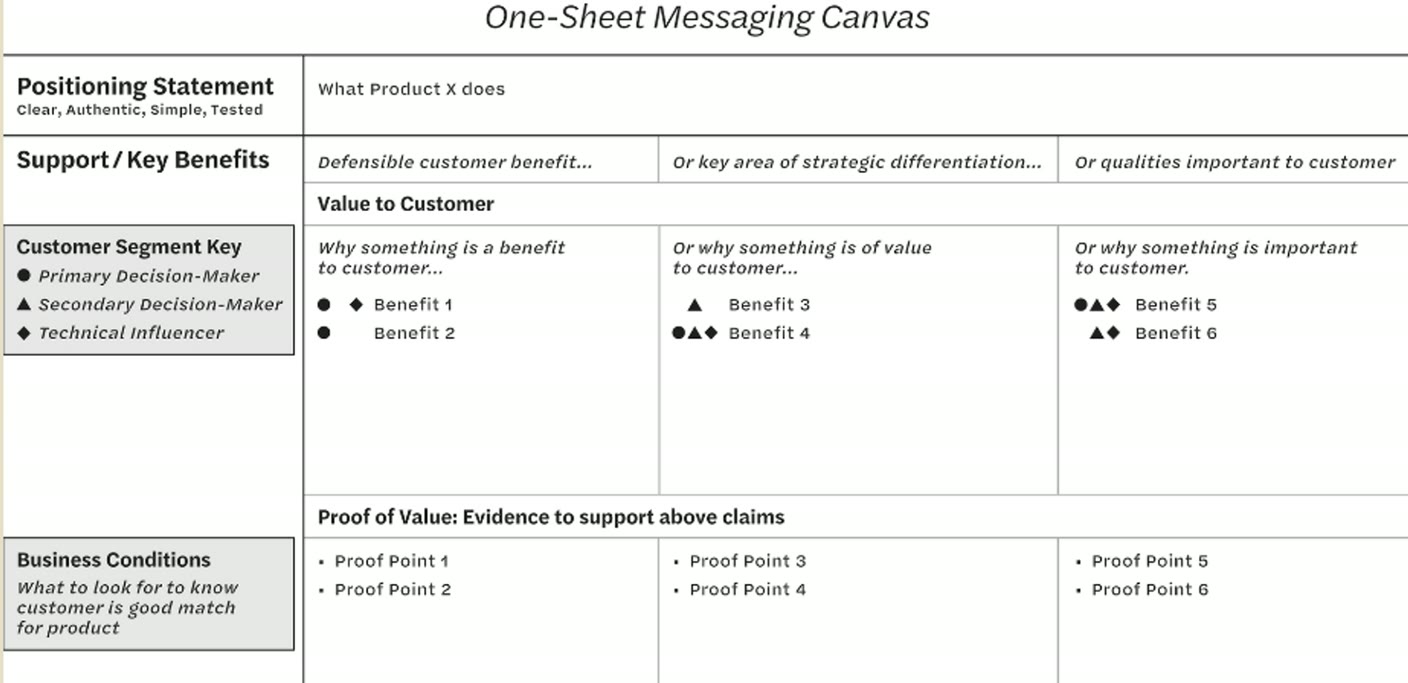
One-Sheet Messaging Canvas
Separates messaging elements into building blocks. You don't use all of them at once, just the ones that fit the current context. The canvas builds the case for why people should believe a product is a good one, and the product's market position should be legible throughout.