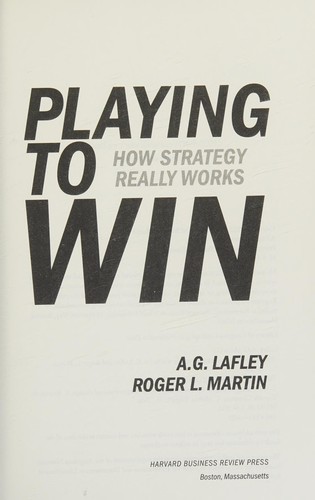
Review
Strategy books usually fail in one of two ways. Either they're so abstract you can't act on them, or they're a case study dressed up as a method. This one avoids both by reducing strategy to five questions that have to be answered together.
The framing that stuck with me is that strategy is a set of choices about where you will compete and how you will win there, and that a choice which excludes nothing isn't a choice. Most of what gets called strategy in product organisations is a list of ambitions with no losing option anywhere in it. Once you're asked where you have explicitly decided not to play, a lot of documents fall apart.
The Procter and Gamble examples get repetitive, and if you don't care about laundry detergent you'll skim. That's a real cost, because the ideas deserve better illustration than one company's portfolio.
What I use from it is the discipline of the cascade: the five answers have to be consistent with each other, and if changing one doesn't force you to revisit the others, you probably haven't made real choices. Read it if you're expected to write strategy and keep producing something that reads more like a plan.
Key Takeaways
The parts worth keeping:
Strategy is five linked choices
| Question | What it forces |
|---|---|
| What is our winning aspiration? | A definition of success specific enough to fail against |
| Where will we play? | Segments, geographies and channels, and everything excluded |
| How will we win? | The basis of advantage in the places you chose |
| What capabilities must be in place? | The few things you have to be genuinely good at |
| What systems are required? | The infrastructure that keeps those capabilities alive |
- The answers have to reinforce each other. If you can change one without disturbing the rest, they aren't choices, they're statements.
A strategy without a sacrifice isn't one
- The test of where-to-play is what you have ruled out. A document that excludes nothing is an aspiration wearing strategy's clothes.
- Being unwilling to lose anywhere guarantees you win nowhere in particular.
- Most organisational disagreement about strategy is really disagreement about what to give up, which is why it stays unresolved while everyone nods at the vision.
Win by being different, not better
- Two routes: cost leadership or genuine differentiation. Trying to hold both usually produces neither.
- Differentiation has to be something customers notice and rivals find awkward to copy. Being marginally better at the same thing is not a position.
Capabilities are the honest part
- The capability question is where strategy meets reality. It asks what you would have to become, not what you would like to achieve.
- If the capabilities you need are the ones every competitor also needs, you have described table stakes rather than an advantage.