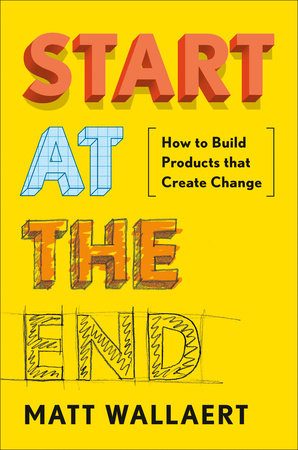
Review
Wallaert's premise is that everything we build exists to change behaviour, and that if you can't state which behaviour, in whom, under what circumstances, you don't yet have a product idea. You have a feature.
The tool at the centre is a behavioural statement: a specific sentence naming the population, the situation, the current behaviour and the intended one. It sounds like a formatting exercise and it isn't. Writing one forces you to be precise about who this is for and what you expect them to do differently, and most product ideas dissolve on contact with that requirement.
The other idea I use is pressure mapping. Rather than asking how to make something more appealing, you list the forces pushing someone toward the behaviour and the forces holding them back, then work on the second set. Teams reliably reach for adding appeal, which is the harder and less effective half.
He's also serious about ethics in a way that's rare in this genre, arguing that if you can engineer behaviour you're obliged to be explicit about whose interests it serves. Given how much of this toolkit overlaps with habit-forming design, that's not a throwaway chapter. The writing is looser than the ideas deserve, but the ideas are good.
Key Takeaways
The parts worth keeping:
Name the behaviour or you don't have an idea
- State who, in what situation, currently does what, and what you want them to do instead. Anything vaguer is not yet actionable.
- The specificity is the value. Most ideas cannot survive being written this precisely, which is useful information early rather than late.
- If you cannot identify a behaviour change, you may be building something that is pleasant and inconsequential.
Map the pressures on both sides
| Force | What it is | What teams do |
|---|---|---|
| Promoting | Reasons someone would do the thing | Add more of these, endlessly |
| Inhibiting | Reasons they don't, including friction and fear | Largely ignore them |
- Removing an inhibiting pressure usually moves more people than adding another promoting one, and it is cheaper.
- The inhibiting forces are harder to see because nobody complains about them; they just quietly don't act.
Insight before intervention
- The intervention should follow from an insight about why people behave as they do, not from a brainstorm about what might be nice.
- Interventions generated without that grounding are guesses dressed as design, and they fail in ways nobody can learn from.
Ethics is not optional here
- If you are deliberately engineering behaviour, you have to be able to say whose interest it serves.
- The test he proposes is whether you would be comfortable explaining the intervention to the person it is aimed at.