Review
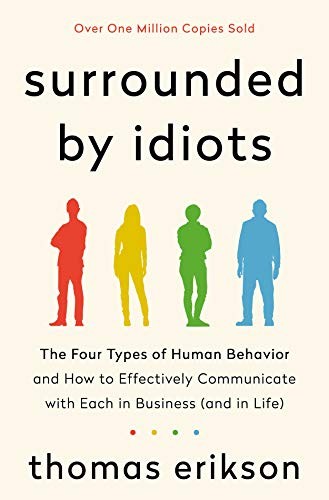
A book that sorts people into four colour-coded behaviour types and explains how to communicate with each. It was recommended to me repeatedly, and I finished it more sceptical than I started.
The useful residue is small but real: people genuinely do differ in how much detail they want, how directly they want to be told things, and how much warm-up a conversation needs. Adjusting for that is a courtesy and it works. If the book gets someone to notice that their default style is not universal, it has done something.
My problem is the scientific framing. The model is presented with far more confidence than personality typing supports, and the underlying instruments have a weak evidential base. The four-box format is memorable precisely because it is simplistic, and memorable simplicity is exactly how you end up with a colleague being dismissed as a colour.
The title is also doing something unpleasant. A book that begins from the premise that the problem is everyone else, then teaches you to categorise them, encourages a habit worth resisting. Read Erikson if colleagues keep quoting it and you want the reference. Do not build a hiring process on it.
Key Takeaways
The parts worth keeping:
The model, briefly
| Type | Wants | Struggles with |
|---|---|---|
| Direct and driving | Speed, the conclusion first | Detail, and other people's pace |
| Outgoing and expressive | Energy, ideas, being heard | Follow-through and specifics |
| Steady and supportive | Stability, warning before change | Conflict, and being rushed |
| Analytical and precise | Accuracy, evidence, time to think | Ambiguity and quick decisions |
What actually transfers
- Your communication default is not neutral. What feels like normal directness to you registers as brusque or vague to someone else.
- Adjusting how much detail and how much warm-up you give is cheap and often the whole fix for a strained working relationship.
- The same message needs different framing for different audiences, which is unremarkable advice that people still fail to follow.
Where to be careful
- The confidence of the presentation outruns the evidence. Personality typing of this kind has a weak scientific base and this book does not acknowledge it.
- Categories become sticky. Once someone is a colour in your head, you interpret their behaviour to fit and stop noticing the exceptions.
- People behave differently under pressure, in different teams, and with different stakes. A fixed type does not survive that.
The framing problem
- Starting from the premise that the problem is everyone else is a poor foundation for a book about communication.
- Used as self-reflection it is mildly useful. Used to classify colleagues it is a way of not listening to them.