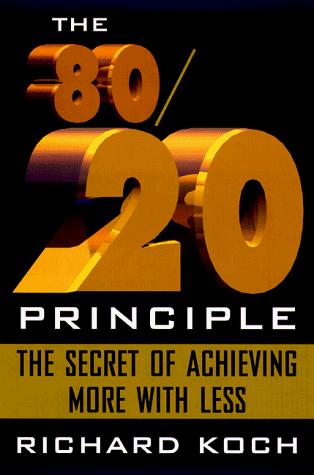
Review
An entire book about the observation that inputs and outputs are unevenly distributed, which is either one idea stretched to book length or a genuinely underused lens, depending on how seriously you take the second half.
The observation itself takes about a page. A small share of causes produces most of the effects, across a startling range of domains. What Koch does with it is push on the consequences: if that's true, then most effort is close to worthless, and the highest-leverage act is identifying and abandoning the unproductive majority rather than working harder across the whole.
Applied to product work it's a decent antidote to fairness-based prioritisation. The instinct to distribute attention evenly across customers, features and problems is exactly wrong if the returns are that skewed. The uncomfortable version is that it also applies to people and projects you're fond of.
The book is repetitive well past the point of necessity, and the business-strategy chapters are weaker than the personal ones. There's also a circularity problem: you can only identify the productive minority in hindsight, and the book is vague about how to spot it in advance. Read the first third.
Key Takeaways
The parts worth keeping:
The distribution is the point
- Effects are rarely proportional to causes. A minority of inputs typically produces the large majority of results, in revenue, in defects, in usage and in almost everything else measurable.
- The ratio is not a law, it is an observation about skew. The specific numbers matter far less than noticing that even distribution is the exception.
- Assuming proportionality is the default mental model and it is usually wrong.
Subtraction beats effort
- If most activity produces little, the largest gain comes from stopping things rather than from doing everything faster.
- This is much harder than it sounds, because the unproductive majority is where most commitments, habits and relationships live.
- Doing less, better, is the whole recommendation, and it conflicts with every instinct about diligence.
Where it applies in product work
- Usage concentrates. A handful of features carry most of the value and the rest are maintained out of obligation.
- Revenue concentrates. Serving all customers equally is a decision to underserve the ones who matter most.
- Defects concentrate. A small number of components generate most of the failures, and they are usually well known to the team.
The honest weakness
- Identifying the productive minority is straightforward looking backwards and genuinely hard looking forwards, which is when you need it.
- Applied carelessly it becomes a licence to neglect anything not currently producing, including things that have not had time to.