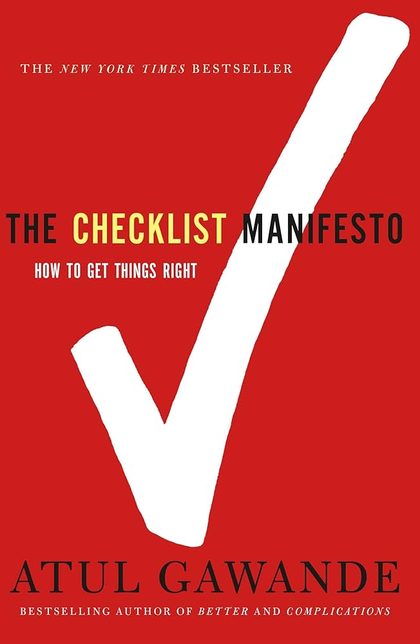
Review
Checklists occupy a strange position in product and operations work. Teams either dismiss them as too rudimentary or inflate them into compliance rituals that no one reads after the first week. Gawande cuts through both of those failure modes with a sharper argument, and this ended up being one of the more useful books I read that year.
The practical guidance on building a good checklist is distributed through the narrative rather than assembled anywhere. If you want the framework, you extract it from the stories as you read. For a book whose central argument is that structure and clarity save lives, that's an odd structural choice. It didn't ruin the book, but I noticed it each time a useful principle appeared mid-chapter and disappeared into the next anecdote.
The core claim isn't that checklists are useful for forgetful people. It's that the world has accumulated more expert knowledge than any single expert can reliably apply under pressure. Surgeons and pilots know what they are supposed to do; they still miss steps. The gap between knowing and doing is where failures happen. A checklist doesn't replace expertise. It protects expertise from the conditions that degrade it: time pressure, fatigue, and the false confidence that comes with experience.
The insight I keep returning to is about teams, not individuals. Gawande describes a pause point: a moment before a high-stakes task where the team stops, each person states their name and role, and the critical steps are confirmed out loud. Not because anyone forgot the steps. Because spoken confirmation transfers knowledge across the group and creates shared ownership of what happens next. That's not a memory tool. That's a coordination mechanism. Product teams building launch processes or incident response runbooks should read this section carefully.
Great read. Worth recommending to anyone who designs processes for teams, not just individual contributors.
Key Takeaways
The parts worth keeping:
Two kinds of failure
- Errors of ignorance: we don't know what to do. Solved by learning more.
- Errors of ineptitude: we know what to do and fail to do it correctly. The knowledge is there; the reliable execution is not. These are the target. No amount of additional training fixes them.
- Most process failures in high-stakes fields are ineptitude errors. Most process improvements are designed as if they were ignorance errors. That mismatch is where a lot of effort goes to waste.
Two checklist types
| Type | How it works | Best for |
|---|---|---|
| DO-CONFIRM | Perform the task from memory, then run through the checklist to verify each step was completed | Experienced practitioners who need a reliable backstop, not a script |
| READ-DO | Read each item and complete it before moving to the next | High-stakes sequences where order matters and any deviation is dangerous |
What makes a checklist actually work
- Short. Five to nine items is the target. Longer than that and it becomes something to file, not something to use.
- Focuses on the steps most likely to be missed under pressure, not the steps everyone always remembers. The routine items don't belong on the list.
- Defines a pause point in advance: a specific moment when the checklist is activated. If activation is optional, it won't happen when it matters most.
- Uses plain, unambiguous language. No interpretation required at the point of use. Clarity that survives a bad day is the goal.
- Tested in a real scenario before it's trusted. A checklist written at a desk is a hypothesis about what matters. Running it in the actual setting reveals what the desk could not.
- Maintained: revisited as the work changes. A checklist from eighteen months ago that nobody has touched is a liability.
The pause point as a coordination tool
- Before a critical task, a brief team check-in where each person names their role and confirms the key steps creates shared situational awareness that silent, individual preparation cannot.
- The goal isn't to verify that the experts know what they are doing. It's to ensure the whole team knows what each person is doing, and that everyone is operating from the same assumptions.
- Problems that are visible to one person and invisible to everyone else account for a significant share of high-stakes failures. A spoken pause point surfaces those problems before the task starts, not after.