Review
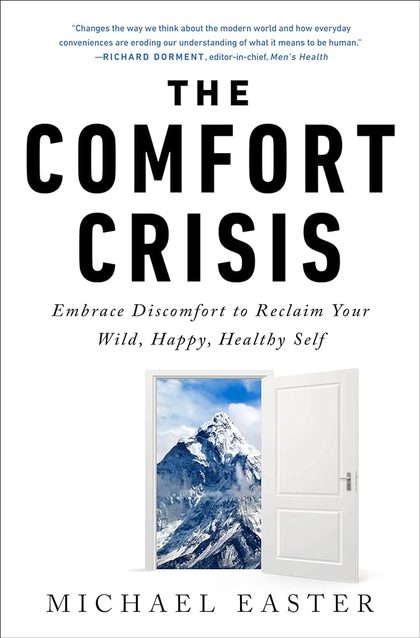
I run cold. Short sleep, heavy rucksacks on weekend hikes, cold showers that I will never fully enjoy. There's a pattern to it, but I'd never given it a proper intellectual frame. The Comfort Crisis looked like it would supply one.
The core argument is hard to argue with. Modern life has stripped out almost every form of involuntary hardship, and the result is a population that has become genuinely fragile: not just physically, but psychologically. Easter backs this up with research that covers more ground than the usual fitness-book fare, pulling in stress physiology, evolutionary biology, and the psychology of boredom. The sections on silence and thermal discomfort are short and usefully specific.
The Misogi idea is the real anchor. The concept is Japanese in origin: identify one challenge per year with roughly a fifty percent chance of completion, even if everything goes right. Two rules only. It has to be genuinely hard. You can't die. That's it. The point is not the event itself. Survive something with real failure risk, and small annoyances stop registering as problems. The 364 days that follow are shaped by knowing what you were capable of.
The structural problem is that Easter chose to deliver all of this through a running account of a caribou hunt in Alaska. The research and the narrative trade places across the book, and the gap between them is too wide. I kept reading for the science and had to wait out the story. It's not that hunting is uninteresting. It's that it doesn't need to be the spine for a book about voluntary hardship, boredom, and metabolic health, and using it as one forces the reader to do more work than the ideas require.
There are better books that cover similar ground with less friction. I can't recommend this one whole, but the Misogi section and the research chapters are genuinely worth the time it takes to find them.
Key Takeaways
The parts worth keeping:
The core thesis
- Modern life removes involuntary hardship so efficiently that boredom is now a deliberate act. We lack struggle by design, not by accident.
- Comfort thresholds creep upward constantly. The number of problems stays roughly the same; the problems just get more trivial.
- Comfort-seeking was a survival advantage for most of human history. It became a liability the moment survival stopped being the primary challenge.
- Only you are watching. Are you important enough to see it through?
Misogi
A once-a-year challenge calibrated so that success is genuinely uncertain, even under ideal conditions. Not a fitness goal. A psychological, emotional, and spiritual test that happens to involve your body.
- Rule 1: It has to be genuinely hard. Aim for roughly a fifty percent chance of success if everything goes right.
- Rule 2: You can't die.
- Not a marathon or a race. Something unusual, with a clear objective and a real chance of failure built into its design.
- Survive something with genuine failure risk and small annoyances stop registering as problems. Gratitude follows without effort.
The research
| Topic | What the evidence shows |
|---|---|
| Voluntary adversity | Consistently improves psychological wellbeing and resilience. Avoiding hardship doesn't protect you from it; it makes you worse at handling it when it arrives. |
| Cardiovascular and metabolic disease | Challenge exposure has measurable protective effects across heart disease, obesity, and diabetes outcomes. |
| Depression and anxiety | Exercise outperforms medication in the data. The prescription requires more effort, which is why it gets skipped. |
| Boredom and solitude | Short periods of both are restorative. Constant stimulation prevents psychological recovery and raises the baseline threshold for what feels engaging. |
| Physical limits | When effort feels impossible, that signal comes from the mind, not the body. The actual physical limit is much further away than it feels. |
Practical notes
- Rucking combines strength and cardio in one session with around six times fewer injuries than running. Add weight progressively and make it social when you can.
- Silence outperforms almost everything marketed as calming. It's free and requires no equipment or subscription.
- Twenty minutes in nature measurably drops blood pressure, heart rate, and circulating stress hormones.
- Most eating past hunger is dopamine-seeking, not fuel. Knowing the difference is more useful than any tracking app.
- The gap between what you think you eat and what you actually eat is almost always larger than you expect. Track it for two weeks to calibrate, then stop.
- Rhythmic breathing during sustained effort gives the mind something concrete to hold onto. Focus only on the breath and the pace of the work.
- Thinking about death regularly isn't morbid; it's clarifying. Easter recommends three times daily. Start with once.