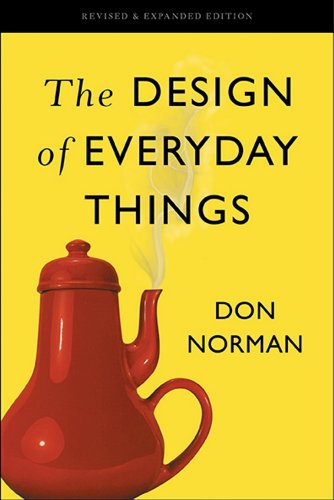
Review
This book earns its reputation. Before I read it, bad design was something I noticed and forgot. After, it is something I see and name: the door with a pull handle that only pushes, the button that beeps before registering your press, the interface that offers no feedback on what just happened. The core concepts are foundational and they generalize well beyond any single product context. Affordances gave me a cleaner language for accessibility thinking. Conceptual models helped me be more precise about what product messaging actually communicates to a user who knows nothing about how the system works. Developing shared vocabulary around these ideas has made design conversations with colleagues move faster. Consistently applicable, regardless of how much time has passed since I first read it.
Key Takeaways
The parts worth keeping.
Core Concepts
- Norman doors: named after the author. Doors that do not open the way you expect because the design signals the wrong action.
- Affordance: A capability made possible by the relationship between a person and an object. A flat plate affords pushing. A handle affords pulling.
- Signifier: Anything that communicates the purpose, structure, or operation of a device. Where affordances exist, signifiers make them discoverable.
- Mapping: The relationship between controls and the actions or results they produce. Good mapping is intuitive. Bad mapping causes errors.
- Feedback: How a system communicates that a request is being processed or is complete. The absence of feedback is one of the most common design failures.
- Conceptual model: The user's simplified understanding of how something works. When the designer's model and the user's model diverge, problems follow.
- Gulf of execution: The gap between what a person wants to do and knowing how to do it within the system.
- Gulf of evaluation: The gap between the system's actual state and how the person perceives and interprets it.
Seven Stages of Action
- Form the goal
- Plan the action
- Specify an action sequence
- Perform the action sequence
- Perceive the state of the world
- Interpret the perception
- Compare the outcome with the goal
Seven Fundamental Design Principles
- Discoverability. Can you tell what actions are possible and what the current state is?
- Feedback. Full and continuous information about the current state, especially after actions.
- Conceptual models. Give users a model of the system that helps them predict what will happen.
- Affordances. The right affordances make desired actions possible.
- Signifiers. Make affordances perceivable. Visibility drives discoverability.
- Mappings. Make the relationship between controls and outcomes predictable.
- Constraints. Reduce possible actions to ease interpretation. Physical, logical, semantic, and cultural.
Constraints
- Physical: The object's form limits what operations are possible.
- Cultural: Shared conventions constrain acceptable actions.
- Semantic: Only certain combinations make sense given the context.
- Logical: Spatial or functional layout implies a correct sequence. Reassemble something, find a leftover part, and logic tells you something went wrong.
A special case: the forcing function.
| Type | How it works |
|---|---|
| Forcing function | A physical constraint such that failure at one stage prevents the next step from happening. |
| Interlock | Forces operations into the correct sequence. A washing machine door that will not open until the drum has drained. |
| Lock-in | Keeps an operation active to prevent premature stopping. A warning when you try to close an unsaved document. |
| Lock-out | Prevents entry into a dangerous space or prevents an event from occurring. The pin on a fire extinguisher preventing accidental discharge. |
The tradeoff: make a forcing function too annoying and people will try to disable it. Minimize the nuisance while retaining the safety function.
Other Principles Worth Keeping
- Put information in the environment. Reduce the cognitive burden of having to remember things.
- Exploit natural mappings and forcing functions.
- Make things visible on both sides: feed-forward (what options are available) and feedback (what just happened).
- Usability is often not prioritized in purchasing decisions, especially when the buyer is not the user.
- Consistency in design is valuable. People transfer learning readily from one system to another; do not break that without good reason.
- Skeuomorphic: incorporating old, familiar cues into new technology even after they serve no functional purpose.
- Design research is deep insight from a small number of people. Market research is shallow insight from a large number. Neither alone is sufficient.
- There is no such thing as the average person.
- Complexity is fine. Confusion is the failure.
- Design is successful only if the product is purchased, used, and enjoyed.