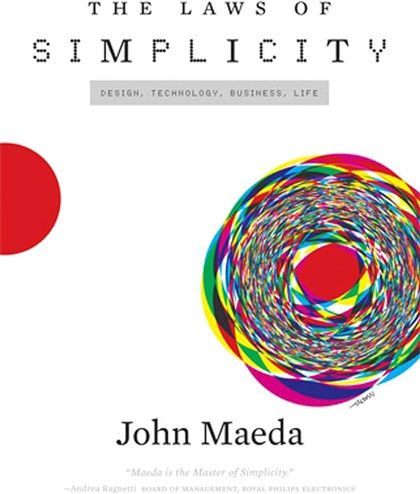
Review
Simplicity is something I come back to constantly, in product design, in writing, in how I structure my own work. I came to this book with real appetite for it.
The first half earns that appetite. The early laws, especially Reduce, Organize, and Learn, give you concrete frameworks with real examples. Maeda does not just state principles; he shows you the thinking behind them. That part of the book is worth your time.
The second half is where I stopped believing him. The ideas get thinner, the reasoning gets looser, and by the end I was reading out of obligation rather than interest. A book about simplicity that loses the thread in its own second act has a problem.
If this topic interests you, read Norman's "The Design of Everyday Things" first. That book is what this one is trying to be.
Key Takeaways
The parts worth keeping
The 10 Laws of Simplicity
- Reduce: the simplest way to achieve simplicity is through thoughtful reduction. Three moves:
- Shrink: make it smaller and lighter. Lower expectations, then exceed them. (The iPod fits in your hand; the mirrored back made it feel smaller.)
- Hide: conceal complexity until it is needed. The clam-shell phone, the menu bar.
- Embody: once you have shrunk and hidden, invest in perceived quality so less feels like more.
- Organize: organization makes a system of many appear fewer, but only when the number of groups is significantly less than the number of items. Four moves:
- Sort: find natural groupings
- Label: assign a name to each group
- Integrate: merge groups that are significantly similar
- Prioritize: put the vital few into a single set so they receive the most attention
- Time: savings in time feel like simplicity. Speed is often attributed to the experience of a simpler system.
- Learn: knowledge makes everything simpler. Three moves:
- Relate: connect to what people already know
- Translate: make the relationship concrete
- Surprise: add something unexpected to make the experience feel worthwhile
- Differences: simplicity and complexity need each other. Neither has meaning without the other.
- Context: what lies in the periphery of simplicity is not peripheral. There is a tradeoff between being lost in the unknown and found in the familiar. Complexity implies the feeling of being lost; simplicity implies the feeling of being found.
- Emotion: more emotions are better than less. Feeling follows form, not the reverse. Great art makes you wonder. Great design makes things clear. Achieving clarity is not difficult; achieving comfort is harder.
- Trust: in simplicity we trust. Two dimensions: how much the system knows about you (the more it knows, the less you have to think), and how much you know about the system (the more mastery you have, the more control you can exert). Trust must be earned and continuously repaid.
- Failure: some things can never be made simple.
- The One: simplicity is about subtracting the obvious, and adding the meaningful.
Three Keys
- Away: more appears like less by moving complexity far away
- Open: openness simplifies complexity
- Power: use less, gain more