Review
I read this in 2020, partway through a difficult product cycle, and parts of it landed harder than I expected. Belsky writes for people in the thick of it: the stretch between the launch high and the "we made it" story, where you're mostly improvising and trying not to unravel. For an early-stage founder or someone building their first real team, the book is dense with practical operational advice, and the framing around enduring versus optimizing gives structure to what usually feels like chaos.
For anyone who has been through a few cycles already, the ratio shifts. Most of what Belsky teaches is knowledge you have already internalized, or learned from harder teachers than a book. A handful of the tactics are genuinely sharp, but it won't surprise a seasoned builder.
Worth reading if you're earlier in the journey. Pair it with the Y Combinator "How to Start a Startup" lectures and you will have a solid picture of what that stretch actually demands.
Key Takeaways
The parts worth keeping
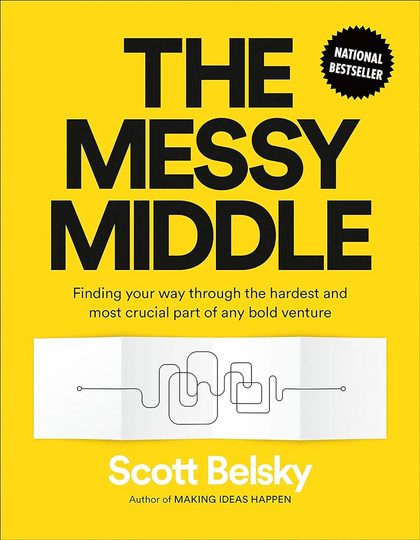
The book's central argument: the messy middle is the period between a project's start and its eventual outcome. Nobody chronicles it because it's unappealing and too revealing. Yet it's where everything important happens. Belsky organizes survival of this period into two interleaved modes: Endure (maintaining the energy and conviction to keep going) and Optimize (continuously improving what is working). Both are always active. The mistake is treating them as sequential.
Endure
- Without customers or visible progress, there's no natural reward loop. You have to manufacture optimism. This isn't self-delusion; it's a skill.
- You're many decisions away from success, but always one decision away from failure.
- Change your path but not the destination. Pivoting on tactics is fine; abandoning the mission is not.
- Your weird is the source of your power. The traits that make you feel out of place are frequently the ones that differentiate your work.
- Beware of insecurity work: tasks with no real intention, so fast you can do several a day, that create the feeling of progress without moving anything forward.
- Self-awareness starts with recognizing that at a peak or a valley, you're not your most objective self.
- There's a massive lag between innovations and results. Belsky cites Bezos: a good quarter today reflects decisions made 3-5 years ago. Patience here isn't passive.
- The easy path leads to a crowded place. The harder option is usually the one your competitors can't copy.
- Break long-term goals into chapters: clear, named milestones underscored by why they matter. Teams do tactics; leaders hold the chapters.
- Six phases of leading a personal reset after a setback: feeling the anger, removing yourself, dissecting what happened, acknowledging your role in it, drafting the new narrative, re-entering the work.
- The best way to complain is to make things. Doing the work gives you more influence than commentary ever will.
Optimize
- The optimize mindset in one question: why did that work, and how do you repeat it?
- On teams: initiative beats experience as a hiring filter. Diversity drives differentiation. Psychological safety isn't soft; top teams report more mistakes because they are free to surface them.
- Foster apprenticeship: find ways for the new to work directly alongside the experienced. Seniority and novelty shouldn't operate in separate lanes.
- Culture is created through stories, and the early ones stick longest. They tell people what "uniquely us" means before any values document does.
- Never outsource your competitive advantage. Speed through the generic work; protect the few things that actually differentiate you.
- Install process to solve your team's problems, not to manage your own anxiety. Give people the problem; respect how they solve it.
- Present ideas, don't promote them. The person who did the work should present the work.
- Delegate, entrust, debrief, repeat. Everyone should know what they are doing and why it connects to the mission.
- Simple is sticky. It's hard to make a simple product and even harder to keep it simple. Make one subtraction for every addition.
- The greatest cost of sustaining too many initiatives is having too little force behind each one.
- Do, then show, then explain. Getting new users to do something is the most powerful form of onboarding. Explanation is the weakest.
- Build your narrative before your product. Best to market beats first to market.
- On metrics: measure each feature by its own intended outcome, not a universal proxy. Track fewer things so you actually change them. Boil the business down to one or two core metrics, and keep re-evaluating whether they still point at what matters.
- Two types of commitments. Active commitments are things you willingly invest in. Passive commitments are things you continue out of guilt or inertia. When you stop nourishing something, let it go.