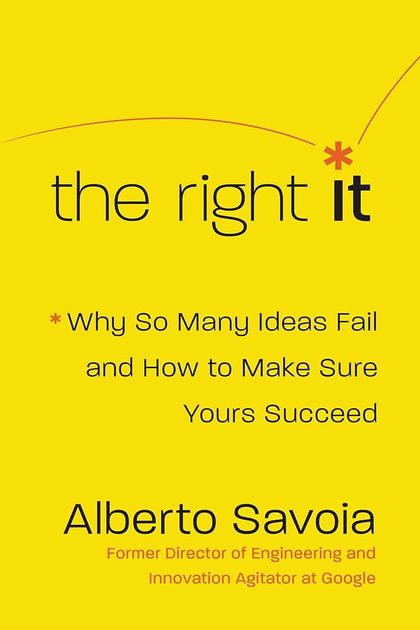
Review
The best book I've read on validating a product idea before you build it. Cagan admits in Inspired that most features miss the mark, and the ones that land only get there through heavy iteration. Savoia takes that admission and builds an entire method around it. I share this book constantly.
The theory is cleanest when applied pre-product, when you are still deciding whether to build anything at all. I would genuinely read a sequel about validating incremental bets inside an established company, where the zero-to-one assumptions do not fully hold.
One gripe: the author cannot resist coining a new term for everything. It is becoming its own genre in product management writing.
Key Takeaways
The parts worth keeping:
- Two things have to be true before you build: the idea has to be The Right It, and the execution has to be right too. Great execution cannot rescue The Wrong It, and most new products fail even when built competently.
- You cannot judge whether something is The Right It by thinking about it. Savoia calls untested reasoning "ThoughtLand." The only way out is to take the idea to market.
- Other people's opinions and data are worth almost nothing. Collect Your Own Data, YODA, instead.
- Not all data is equal. Weigh it by how much skin in the game the person offering it has: money beats reputation, reputation beats time, time beats everything else. A pre-order is worth more than a compliment.
- Turn a vague idea into something testable: frame it as a Market Engagement Hypothesis, then tighten that into an XYZ hypothesis (at least X% of Y will Z), then shrink it into smaller, easier-to-test versions of the same hypothesis.
- Working mindset: think globally, test locally. Think cheap, cheaper, cheapest. Test now rather than later. Tweak it and flip it before you quit it.
- Running this loop does not guarantee success, but it makes failure cheap and fast when it happens, and it is the surest route to finding an idea that is actually The Right It.
Pretotyping techniques
Ways to test a hypothesis before you build anything real, ranked roughly by how little you have to build:
| The Mechanical Turk | Fake the automation, have a human do the work behind the scenes |
| The Pinocchio | A non-functional prop that stands in for the real product |
| The Fake Door | Offer something that doesn't exist yet and see who tries to walk through |
| The Facade | Build only the front end of a much bigger system you're pretending exists |
| The YouTube | Show the product working in a video before it actually does |
| The One-Night Stand | Run it once, manually, for a single real customer |
| The Infiltrator | Insert your offer into an existing product or channel you don't own |
| The Relabel | Rebrand an existing product as your own to test demand |
The full validation loop
- Start with an idea
- State it as a Market Engagement Hypothesis
- Sharpen that into a testable XYZ hypothesis
- Break it into smaller, easier-to-test hypotheses
- Run pretotyping experiments to collect YODA
- Weigh that data by skin-in-the-game
- Decide: go for it, drop it, or tweak it and go again