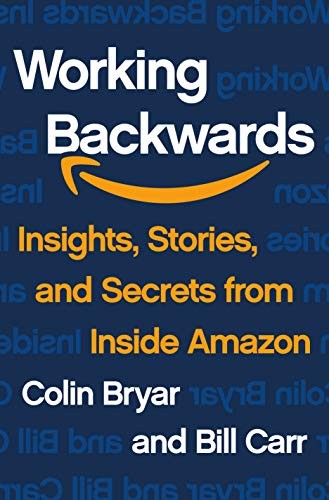
Review
I went in sceptical, because books written by former executives about how their famous employer does things tend to be a long way from useful. This one is better than that, and the reason is that it's specific about mechanisms rather than culture.
The part worth the price is the practice of writing the press release and the customer questions before building anything. It sounds like a gimmick and it isn't. Forcing yourself to describe the finished thing in plain language, to a customer who does not care about your architecture, exposes a weak idea faster than any amount of specification. Several things I've worked on would have died earlier and cheaper under that test.
The chapter on replacing presentations with written narratives is the other one I'd defend. A deck lets you hide a shaky argument behind bullet points and delivery. Six pages of prose does not, and the silent reading at the start of the meeting means everyone actually engages with the same thing.
My caveat is the obvious one. These mechanisms grew inside a company with the appetite to enforce them, and lifting one into an organisation that will not defend it produces theatre. The book is honest that the mechanisms are interlocking, which is more self-aware than most of its genre. Read it for the practices; ignore the parts that read as company history.
Key Takeaways
The parts worth keeping:
Start from the customer and work back
- Write the announcement and the customer questions before building. If you cannot describe the benefit in plain language to someone who has no interest in how it works, you do not have a product yet.
- The document is a filter, not a formality. Its purpose is to kill weak ideas while killing them is still cheap.
- Revise it until it is genuinely compelling, and treat repeated failure to get there as an answer rather than a writing problem.
Narratives instead of slides
- Meetings open with everyone silently reading a written document. It feels strange once and then feels obviously correct.
- Prose forces the argument into the open. Bullet points let a presenter carry a case that the reasoning would not support on its own.
- The cost is real: writing well takes far longer than assembling slides, and that cost is the point.
Measure inputs, not just outcomes
| Kind | Example | Why it matters |
|---|---|---|
| Input | Selection, price, delivery speed | You control it directly, and moving it moves the outcome |
| Output | Revenue, profit, share price | You cannot act on it, only report it after the fact |
- Teams that steer by output metrics end up reacting to last quarter. The work is finding which inputs actually drive the output, which is harder than picking the output.
Structure so teams can move
- Give an initiative one owner whose job is that initiative and nothing else. Shared ownership across busy leaders is the most common quiet cause of slow progress.
- Organise so that teams can build without waiting on each other. Dependencies, not headcount, are usually what caps speed.
- Hiring is treated as a process with a person whose role is to defend the standard against the urgency of the vacancy. Without that role the bar drops exactly when hiring is most pressured.